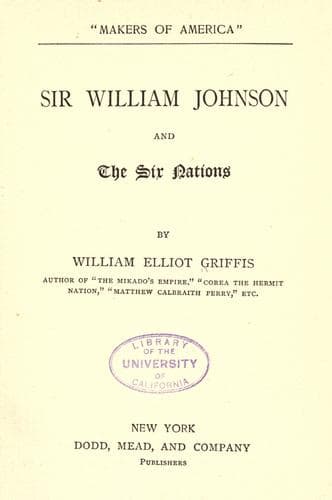
Sir William Johnson and the Six NationsGriffis, William Elliot
History
Sir William Johnson and the Six Nations
Griffis, William Elliot
Johnson, William, 1715-1774; United States -- History -- French and Indian War, 1754-1763
During this year Johnson was unusually active with the Indians, in
holding their loyalty to the British side or in maintaining their
neutrality. Many gatherings were held at his own house. In the great
council held at Easton, Penn., in October, 1758, five hundred Indians
were present, including delegates from all the Six Nations, the
Shawanese, Miamis, and Moheganders. The principal figure was
Teedyuscung, who insisted on his people being treated with the same
dignities accorded to the Iroquois. Indeed, if the explanation of the
Delawares be accepted, they had, in times long before, and at the
earnest request of the Indians both north and south of them, voluntarily
and by solemn treaty assumed a subordinate position as warriors and
refrained from war, in order to preserve peace, trade, and the general
good of the whole community of red men. They claimed, however, that it
was Iroquois overreaching in diplomacy and even downright treachery,
that made them seem to “accept the petticoat” and become “squaws.” It is
certain that Teedyuscung made it the aim of his life to secure for his
people the respect of the Iroquois and their equality with the proudest
of the red men. The Easton council lasted nineteen days, and was
productive of harmony both between the Indians and the whites, and among
the varied tribes themselves. The one who contributed most to this
gratifying success was not Johnson, but the honest German and Moravian,
Christian Post, who from his home in the Wyoming Valley had made a
journey and mission of peace, alone, among the tribes in the Ohio
Valley.
When Sir Jeffrey Amherst reached America as commander-in-chief of the
British forces, he came at once, with his four regiments at Albany, to
reinforce Abercrombie. He found at Lake George, by the end of May,
twelve thousand New York and New England militia. Johnson at once urged
upon him the importance of capturing Niagara, the port between the two
great lakes. Amherst agreed to the proposal, and warmly seconded it. In
place of the stockade which the French from the time of La Salle had
maintained, there was now a formidable fort. To Sir William Prideaux was
assigned the work of reducing this Western stronghold; and Johnson, in
order to assist him, called a council at Canajoharie to enlist the
Mohawks, Senecas, and other Indians in the expedition. After the usual
eloquence and expenditure of war-belts of wampum, Johnson led into the
field seven hundred warriors, whose painted faces showed they were on
the war-path. The Swegatchie braves also swelled this following, so that
on arriving at Niagara he wrote to William Pitt, Oct. 24, 1760, that his
Indian force numbered nine hundred and forty-three men.
Public-domain text, read in full here on John Shaqi.
Reviews
Reviews
No reviews yet
Be the first to share your thoughts on this work.
Elsewhere in the archive
Join the Discussion
Join the discussion
Sign in to leave a comment or review.
Sign InorCreate an account