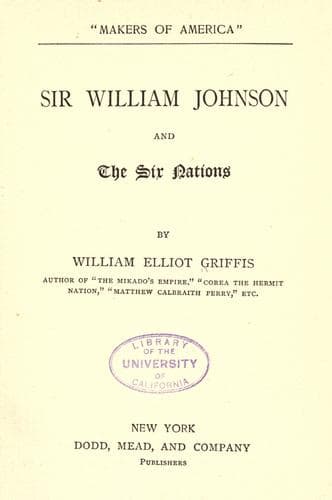
Sir William Johnson and the Six NationsGriffis, William Elliot
History
Sir William Johnson and the Six Nations
Griffis, William Elliot
Johnson, William, 1715-1774; United States -- History -- French and Indian War, 1754-1763
By the 7th of July Prideaux with thirty-two hundred men, including
Johnson’s Indians, began siege operations. On the twelfth day he was
killed in the trenches by the bursting of a shell from a coehorn mortar.
This left the command to Johnson, who renewed operations with greater
vigour, and by the 22d breached the wall sufficiently for assault.
While active in the trenches with hot shot, bombs, and canister, Johnson
did not forget to keep out his scouts and rangers. From them he learned
that the French officer D’Aubrey was advancing to the relief of the
garrison with twelve hundred men whom he had gathered from all the four
French posts on the lakes. Leaving a force to continue the bombardment,
Johnson marched out with infantry and grenadiers, having the Indians on
his flanks, and attacked the advancing French with vigour. In this
battle the Indians fought like genuine soldiers, and threw the French
into disorder. Seeing this, the charge of the regulars and militia was
made with such force and fury that in less than an hour the fight was
over, and a splendid victory for the English was the result.
Returning to camp and trench, Johnson sent Major Harvey to Captain
Pouchot, the French commander, to tell of the defeat of D’Aubrey, and to
advise capitulation, especially while it was possible to restrain the
Indians. Pouchot yielded; and the surrender of the whole force of over
six hundred took place the next morning. Johnson wisely had ready an
escort for the French prisoners, and not one of them lost his scalp or
was rudely treated by the Iroquois. While the women and children were
sent to Montreal, the men were marched by way of Oswego to New York, to
fill English prisons. The manner in which Johnson restrained the savages
was in marked contrast to the butcheries allowed, or only with great
difficulty prevented, by the French under similar circumstances.
Johnson’s victory at Niagara broke the chain of French forts along the
great valleys and water-ways from the mouth of the St. Lawrence to the
delta of the Mississippi. One after another the French deserted the
other forts, except Detroit; and General Stanwix at once occupied them
or their ruins. Leaving Colonel Farquar at Niagara with a garrison of
seven hundred men, Johnson came to Oswego, there meeting General Gage,
who had been appointed to succeed Prideaux. Gage, perhaps irritated that
the provincial fur-trader or “Heaven-born general” had, instead of
himself, won the most brilliant of victories, refused to allow Johnson
to advance and destroy the French forts at La Galette and Oswegatchie,
or Ogdensburg. Finding that Gage, despite his advice and that of
Amherst, meant to do nothing of importance until the next year, Johnson,
after meeting the chief men of the Ottawa and Mississagey Indian tribes,
returned home. He was now the most popular man in the province; while
his name in England was joined with that of his fellow-tradesman, Clive,
as a “Heaven-born general.”
Public-domain text, read in full here on John Shaqi.
Reviews
Reviews
No reviews yet
Be the first to share your thoughts on this work.
Elsewhere in the archive
Join the Discussion
Join the discussion
Sign in to leave a comment or review.
Sign InorCreate an account