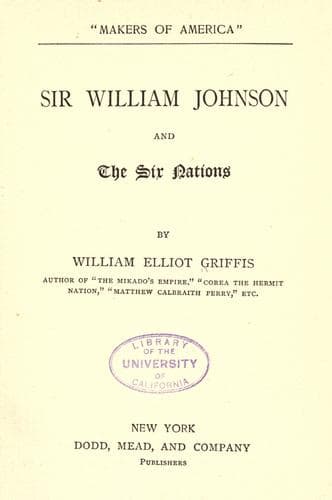
Sir William Johnson and the Six NationsGriffis, William Elliot
History
Sir William Johnson and the Six Nations
Griffis, William Elliot
Johnson, William, 1715-1774; United States -- History -- French and Indian War, 1754-1763
At his home Johnson learned that the French had at last abandoned
Ticonderoga and Crown Point, but by concentrating at the northern end of
Lake Champlain and fortifying their position, blocked the British
advance to Montreal. Amherst was therefore obliged to rest for the
winter; having first rebuilt the great fortresses, constructed Fort
George near the site of old Fort William Henry, and cut a road from the
New York lakes into the heart of New England. Critics of the
over-cautious Amherst say he should have pushed on and helped Wolfe to
conquer Quebec earlier. However, after so many mistakes and disasters
arising from rashness, such a man as Amherst was, perhaps, necessary.
Wolfe, however, succeeded, and on the Plains of Abraham won America for
Teutonic civilization, finding the path of glory a short one to the
grave.
Montreal still remained to the French; and when, the winter over, it was
resolved to attack this last stronghold from three points, Amherst with
the main army assembled at Schenectady was to proceed by way of Oswego
down the “ocean river” of Lake Ontario and the St. Lawrence, General
Murray was to ascend the river from Quebec, while Colonel Haviland was
to advance by way of Lake Champlain. The colonial militia came in
slowly; but by the 12th of June Amherst left Schenectady with twelve
thousand men; while Johnson, arriving at Oswego July 25, led the first
detachment of six hundred Iroquois fighting men. His influence was
however so great that before embarking on Lake Ontario he had, from the
tribes formerly neutral, won over seven hundred more warriors. He also
sent runners with wampum belts to nine tribes of Indians living near
Montreal. These, on his arrival at Fort Levi, at once declared their
neutrality. It was thus from the danger of eight hundred hostile
warriors, familiar with every square rod of land and water, that
Amherst’s army was saved. Passing through the dangerous Lachine Rapids
with the loss of but forty-six men out of his ten thousand, he reached
Montreal. So perfectly was the plan of campaign carried out, that
Amherst and Murray appeared on opposite sides of the city on the same
day. Haldiman soon appeared from the south, and thus the three English
columns became practically one army within twenty-four hours. The city
surrendered on the 8th of September, 1760, and the French power in
America fell.
So fully were the Indians kept in hand by Johnson, that no atrocities
were committed by them, nor the enemy’s people or country in any way
harmed by their presence. In this campaign, in which the talents of
Johnson shone with conspicuous brilliancy, his military career
culminated.
Public-domain text, read in full here on John Shaqi.
Reviews
Reviews
No reviews yet
Be the first to share your thoughts on this work.
Elsewhere in the archive
Join the Discussion
Join the discussion
Sign in to leave a comment or review.
Sign InorCreate an account