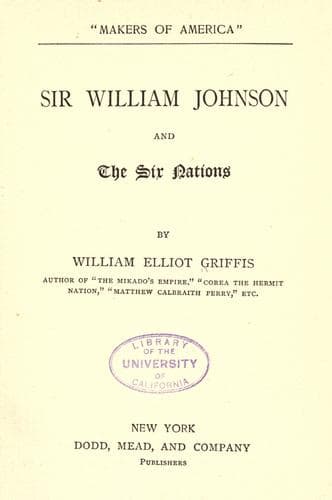
Sir William Johnson and the Six NationsGriffis, William Elliot
History
Sir William Johnson and the Six Nations
Griffis, William Elliot
Johnson, William, 1715-1774; United States -- History -- French and Indian War, 1754-1763
Johnson made the western journey accompanied by Capt. John Butler, his
secretary and prospective son-in-law Lieut. Guy Johnson, and a
body-guard of Oneida Indians. A long line of boats carried the
provisions and the Indian goods intended for gifts. Johnson’s object was
to learn everything possible about the country recently held under
French dominion, and about the Indians living in it. At Fort Stanwix,
where the portage required several days to be spent in unloading and
reloading on account of land transit, Colonel Eyre reached him with a
letter from General Amherst communicating startling news. Apparently
under the instigation of the Senecas, behind whom was Pontiac, all the
tribes from Nova Scotia to the Illinois were being plied by wampum belts
and messages, and a plot to murder the English garrisons was being
hatched. Owing to the warnings given to the garrisons by Captain
Campbell, the plot was, for the time at least, postponed. Johnson
accordingly called a council at Onondaga, and directly charged the
Senecas with dissimulation. He gave them to understand that only by
their appearance in friendly council at Detroit would his suspicions be
allayed and their own safety secured.
A change in Johnson’s domestic arrangements made about this time
probably still further increased the prestige which he had so long
enjoyed among the red men. His wife Catharine died in 1759, and for a
while he illustrated in his own life the injury to morals which war,
especially when successful, usually causes. He lived with various
mistresses, as tradition avers, but after a year or two of such life
dismissed them for a permanent housekeeper,—Mary Brant, the sister of
Joseph Brant. According to the local traditions of the Valley, Johnson
first met the pretty squaw, when about sixteen years old, at a militia
muster. In jest, she asked an officer to let her ride behind him. He
assented, returning fun for fun. To his surprise she leaped like a
wild-cat upon the space behind the saddle, holding on tightly, with hair
flying and garments flapping, while the excited horse dashed over the
parade-ground. The crowd enjoyed the sight; but the most interested
spectator was Johnson, who, admiring her spirit, resolved to make her
his paramour.
Public-domain text, read in full here on John Shaqi.
Reviews
Reviews
No reviews yet
Be the first to share your thoughts on this work.
Elsewhere in the archive
Join the Discussion
Join the discussion
Sign in to leave a comment or review.
Sign InorCreate an account