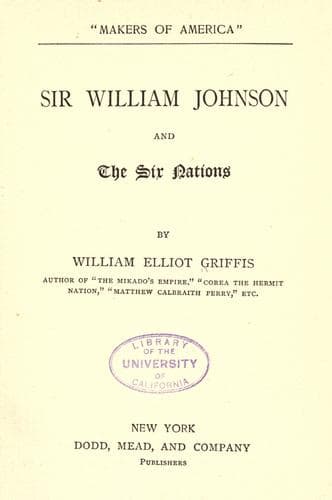
Sir William Johnson and the Six NationsGriffis, William Elliot
History
Sir William Johnson and the Six Nations
Griffis, William Elliot
Johnson, William, 1715-1774; United States -- History -- French and Indian War, 1754-1763
From this time forth Mollie Brant, the handsome squaw, was Johnson’s
companion. Her Indian name was Deyonwadonti, which means “many opposed
to one.” She was a granddaughter of one of the Mohawk chiefs who had
visited London a generation or two before, when “Quider,” or Peter
Schuyler, had shown the King of Great Britain some of his American
allies. Mary Brant was undoubtedly a woman of ability, and with her
Johnson lived happily. She presided over Fort Johnson, and later at
Johnson Hall. She became the mother of a large brood of Johnson’s
“natural” children; and as “the brown Lady Johnson,” white guests and
visitors always treated her with respect. With this new link to bind the
Iroquois to him, the colonel’s influence was deepened far and wide
throughout the Indian Confederacy. To strengthen his ascendancy over the
minds of the Indians, Johnson seemed to hesitate at nothing.
The dangerous journey to Detroit was duly made, and after being waited
on by friendly deputies of the Ottawa Confederacy, the great council was
held on the 19th of September. Here, before the representatives of many
Indian nations from the four points of the compass, he made a great
speech, smoked the pipe of peace in the name of their Great Father the
King, and distributed the presents. The ceremonies wound up with a grand
dinner and ball to the people of Detroit. The return was safely made,
and home was reached October 30.
During the winter of 1761, spent by Johnson in New York in pursuance of
his civil duties, Dr. Cadwallader Colden, the incorrigible Tory, who was
now lieutenant-governor, distinguished himself in further encroaching
upon the liberties of the people, by trying to make the judiciary
dependent on the Crown. Instead of the judges being appointed to hold
office during good behaviour, Colden wanted them to serve at the
pleasure of the king. In other words, he would, by making the king’s
will the term of office, reduce the bench of judges to be the instrument
of the royal prerogative. A lively discussion in the press was carried
on by William Livingston, John Scott, and William Smith, as champions of
the people, who contended vigourously for the principle so long regnant
in the Dutch, and now prominent in the American republic,—the supremacy
of the judiciary. Remembering too well how servile were the English
judges who held office at the pleasure of the Plantagenets, the Stuarts,
and even of Cromwell, the people of New York fought stoutly for their
rights and the republican principle. When Colden desired an increase of
salary for the Boston lawyer who acted as chief-justice, the Assembly
flatly refused to grant it. The salary of the obnoxious Chief Justice
Benjamin Pratt was finally paid out of the royal quit-rents of the
province. Colden wrote to the Board of Trade prophesying the dire
results of the doctrine—embodied in the preamble to the Constitution of
the United States only twenty-six years later—that all authority is
derived from the people.
Public-domain text, read in full here on John Shaqi.
Reviews
Reviews
No reviews yet
Be the first to share your thoughts on this work.
Elsewhere in the archive
Join the Discussion
Join the discussion
Sign in to leave a comment or review.
Sign InorCreate an account