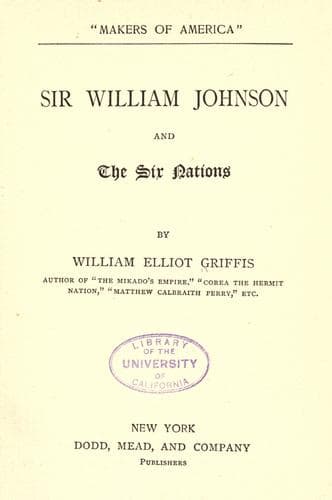
Sir William Johnson and the Six NationsGriffis, William Elliot
History
Sir William Johnson and the Six Nations
Griffis, William Elliot
Johnson, William, 1715-1774; United States -- History -- French and Indian War, 1754-1763
During the great conspiracy and war of Pontiac, Johnson was ceaselessly
active in measures tending to holding the loyalty of the Indians. The
Senecas, always the most wayward, because most easily influenced by the
French, and more susceptible to Indian arguments, at first espoused the
cause of Pontiac. The baronet had no sooner heard of this than he called
a council of all the Six Nations at German Flats, and secured a
tremendous advantage to the cause of civilization, by winning them over
to neutrality. He sent Captain Claus with the same end in view to
Caughnawaga, or the Sault St. Louis. At this place, formerly called La
Prairie, whence had so often issued in the old days, from 1690 and
onward, scalping-parties on the English and Dutch settlements, Claus met
the Caughnawaga, St. Francis, and other tribes of Indians, thus cutting
off another possible contingent for Pontiac. So successful was Claus,
that these Canadian tribes not only sent deputies to dissuade the
Western braves, but also warned them that in case of hostilities they
would fight for the king with their English brethren.
Not knowing what roving bands of Western savages might make sudden
raids, Johnson ordered out the Valley militia, despatched Indian scouts
to Crown Point, built a stockade of palisades around Johnson Hall, and
armed his own tenants and the people of Johnstown. The two stone towers
or block-houses flanking the Hall were mounted with cannon,—the weapons
most objectionable to savages, one of them being a piece captured at
Louisburg, and presented by Admiral Warren. Seeing that the Mohawk
Valley was thus so guarded, the Western braves, though harrying the
frontiers of Pennsylvania and Virginia, kept out of New York. Indeed it
seems not too much to assert that the influence of Johnson over the
Indians east of Detroit was the chief cause of the failure of Pontiac’s
great plot. Angry with this one man because of his power to thwart their
designs, the followers of Pontiac intended to penetrate to Johnstown and
take his life. Hearing of their purpose, the Mohawks, coming in a great
delegation to their Great Brother, offered to serve as his body-guard.
Public-domain text, read in full here on John Shaqi.
Reviews
Reviews
No reviews yet
Be the first to share your thoughts on this work.
Elsewhere in the archive
Join the Discussion
Join the discussion
Sign in to leave a comment or review.
Sign InorCreate an account