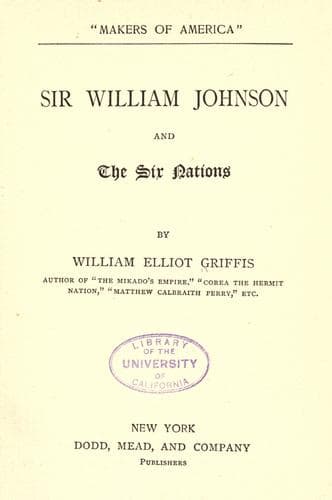
Sir William Johnson and the Six NationsGriffis, William Elliot
History
Sir William Johnson and the Six Nations
Griffis, William Elliot
Johnson, William, 1715-1774; United States -- History -- French and Indian War, 1754-1763
After inviting the sachems of the Six Nations to assemble at his house
to hear his report of the Detroit Council, he examined into the famous
Kayaderosseras or Queensborough patent of several hundred thousand acres
granted in 1708. This patent was one of several which the Mohawks
claimed were fraudulently obtained. Johnson heard both sides fully, and
decided that the Indian claim was the correct one, and that the white
man was in the wrong. The result was that the alleged owner gave full
release. In the matter of the lands on the Susquehanna, in Pennsylvania,
but claimed by Connecticut, the Iroquois were so excited that they sent
a delegation of five chiefs to Hartford. These were led by Guy Johnson,
and bore a letter from Sir William. The Connecticut people held
tenaciously to their claim, and were about to settle, to the number of
three hundred families, in the Wyoming Valley. In the speech of the
Onondaga orator at Hartford, after rehearsing the story of the covenant
with Corlaer, and denouncing men like Lydius and Kloch, who fraudulently
obtained the Indians’ land, he declared the Six Nations would resist,
even unto blood, the loss of their Susquehanna lands. Governor Fitch
heartily agreed with the Iroquois, and so actively seconded the royal
order that the proposed settlement was, at least, postponed.
Johnson predicted in a letter to Amherst, March 30, 1763, “the dangerous
consequences which must inevitably attend the settlement of these people
in the Wyoming Valley.” The Susquehanna Company persevered, however, and
at the council held at Fort Stanwix succeeded in getting from some of
the chiefs—after Johnson had been warily approached with bribes to take
the vice-presidency of the company—a title-deed to the lands. Into this
beautiful valley, twenty-one miles long, and now one of the richest and
most lovely in all Pennsylvania, forty families from Connecticut settled
in 1769. The unsleeping vengeance of the Senecas did not find its
opportunity until 1778. Then, led by Butler and his Tories, the awful
massacre was perpetrated which has furnished the poet Campbell with his
mournful theme.
Public-domain text, read in full here on John Shaqi.
Reviews
Reviews
No reviews yet
Be the first to share your thoughts on this work.
Elsewhere in the archive
Join the Discussion
Join the discussion
Sign in to leave a comment or review.
Sign InorCreate an account