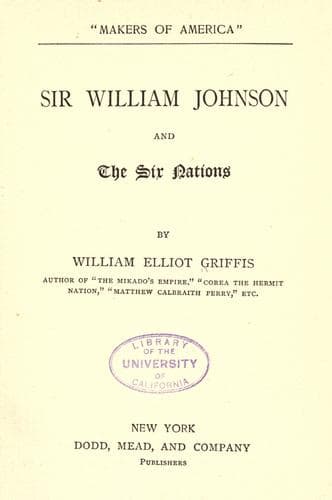
Sir William Johnson and the Six NationsGriffis, William Elliot
History
Sir William Johnson and the Six Nations
Griffis, William Elliot
Johnson, William, 1715-1774; United States -- History -- French and Indian War, 1754-1763
The result of these successes was to cow and terrify the Senecas, who
came to Johnson Hall and made peace. General Gage vigourously pressed
operations against the hostile tribes, and sent Bradstreet westward. As
a reinforcement, Johnson persuaded over five hundred of the Confederate
Iroquois to join Bradstreet. He then went himself to Niagara, arriving
July 8, 1764, to hold a grand council with all the Indians favourable to
the English cause, from Dakota to Hudson Bay, and from Maine to
Kentucky. Besides a treaty of peace with the Hurons, the earth-hunger of
the pale-faces was temporarily satisfied by a cession of land along the
lakes, accompanied with the promise of protection to navigation. The
Senecas also ceded, not for private use, but to the Crown, a strip of
land eight miles wide between Lakes Erie and Ontario, bisected by the
Niagara River. They made a promise of the islands in the river to
Johnson himself, who immediately transferred them to the British
Government. A considerable number of white prisoners were delivered up.
In this policy of possibly mistaken kindness, in which the change of
life to those who had forgotten their old home and friends and had
become habituated to Indian life, was like a resurrection, there were
many incidents like those upon which Cooper has founded his romance of
“The Wept of the Wish-ton-wish.” Johnson’s advertisement to friends of
the captives is one of the pathetic curiosities in the American
journalism of the eighteenth century.
After interviews between Johnson’s agent, Croghan, and Pontiac,
arrangements were made for the amicable dwelling together of the two
races. Johnson had proposed to the Lords of Trade in London that the
territory west of the Ohio River should be forever reserved to the Six
Nations as a hunting-ground. Another great council was held at his house
April 27, at which over nine hundred Indians, including one hundred and
twenty Senecas, the Delaware chiefs Squash-Cutter and Long-Coat, were
present. The various conferences lasted nearly a month, resulting in a
fresh treaty of peace with the Western Indians. They covenanted to allow
the boundary to be made, protect traders, allow the passage of troops,
deliver up murderers to the nearest garrison, and endeavour to win over
the Illinois tribes. Later, Croghan, the agent of Johnson, visited
Detroit, on the way collecting the white captives delivered up, and
meeting the penitent Pontiac, who of his own accord made overtures of
peace and accompanied Croghan. On the 17th of August, at Detroit, he met
the Ottawas, Pottawatamies, and Chippewas, and in one of several
conferences presented Johnson’s road-belt to “open the path of the
English from the rising to the setting sun.” Ten days later, on the
27th, with Pontiac and the tribes of the great Ottawa Confederacy, the
war-hatchet was buried, the tree of peace planted, and the calumet of
peace smoked. Pontiac even gave a promise to visit Johnson at Oswego to
ratify the peace thus made.
Public-domain text, read in full here on John Shaqi.
Reviews
Reviews
No reviews yet
Be the first to share your thoughts on this work.
Elsewhere in the archive
Join the Discussion
Join the discussion
Sign in to leave a comment or review.
Sign InorCreate an account