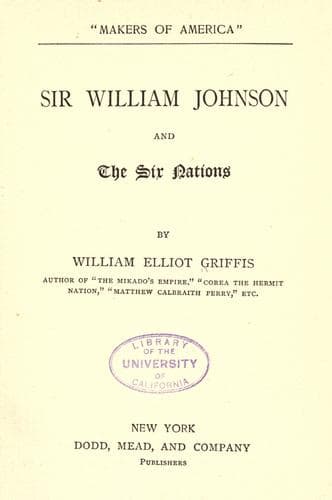
Sir William Johnson and the Six NationsGriffis, William Elliot
History
Sir William Johnson and the Six Nations
Griffis, William Elliot
Johnson, William, 1715-1774; United States -- History -- French and Indian War, 1754-1763
The road being cleared for the passage of
the troops, Captain Sterling, with one hundred Highlanders from Fort
Pitt, received possession, October 10, of Fort Chartres, and the French
flag was hauled down.
True to his promise, Pontiac met Johnson at Oswego July 23. Amid every
possible accessory of impressive display and ceremony, the sacramental
wampum, the sacred promises of peace and tokens of friendship were
exchanged. Then Pontiac and his braves moved out in their canoes over
Lake Ontario to the west and to obscurity. Henceforth the way of
Teutonic civilization was cleared, and the march to the Pacific began.
As we write in 1891, the centre of population is near Chicago.
In October, 1768, the great council called for the purpose of making a
scientific frontier met at Fort Stanwix. This great concourse, not only
of Indians, but of the governors and other distinguished men of
Pennsylvania and New Jersey, makes one of the historical pictures in the
story of America well worth the artist’s interpretation on canvas.
Johnson, being at this time heartily interested in the welfare of St.
George’s Episcopal Church, built next to the British barracks in
Schenectady, in which he was a frequent worshipper, profited by the
presence and happy mood of so many prominent men. He took up a
collection, and secured sixty-one pounds and ten shillings for the
little stone church on whose spire in Ferry Street still veers the
gilded cock of St. Nicholas, the symbol of vigilance and of the
resurrection.
Of the Six Nations and other tribes, thirty-two hundred individuals were
present to witness the bartering away of their birthright for such
pottage as the pale-faces had to tempt these Esaus of the wilderness.
For ten thousand pounds, unlimited rum, and after due exchange of
eloquence and wampum, they sold to the king the ground now occupied by
Kentucky, Western Virginia, and Western Pennsylvania. Fort Stanwix was
dismantled. The Indians moved out of Eastern New York, and the next year
Daniel Boone led that great emigration of white men from the Southern
Atlantic coast which resulted in the winning of the West. Boone’s was a
movement for the annihilation of savagery, the extinction of Latin, and
the supremacy of Teutonic civilization in North America, parallel to
that rolling westward from New England, New York, and Pennsylvania.
This was the last of the most important meetings and negotiations of
Johnson with the men who claimed by hereditary right to occupy the
continent. Though afterward full of toilsome detail, and busy in
conference, in hearing complaints, and securing the performance of
stipulations, Johnson’s constructive career as Superintendent of Indian
Affairs virtually closed at Fort Stanwix.
CHAPTER XII.
LIFE AT JOHNSON HALL.
Public-domain text, read in full here on John Shaqi.
Reviews
Reviews
No reviews yet
Be the first to share your thoughts on this work.
Elsewhere in the archive
Join the Discussion
Join the discussion
Sign in to leave a comment or review.
Sign InorCreate an account