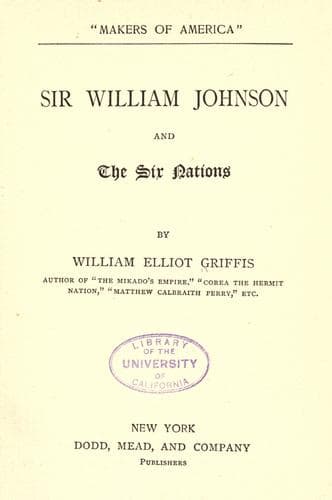
Sir William Johnson and the Six NationsGriffis, William Elliot
History
Sir William Johnson and the Six Nations
Griffis, William Elliot
Johnson, William, 1715-1774; United States -- History -- French and Indian War, 1754-1763
THE last ten years of Johnson’s life were among the busiest of his
career. War matters occupied but a portion of his time. His greater
works were those of peace, his chief idea being the development in
civilization of the region watered by the Mohawk and its tributaries.
The story of his life now concerns itself with the location of settlers;
the education of the Indians; the building of schools, churches, and
colleges; the improvement of land and live-stock; the promotion of
agriculture, and of the arts and comforts of life. In a word, none more
than he carried out the command to replenish the earth and possess it.
Fortune seemed to have no frowns for this one of the chief Makers of
America. Popular with his neighbours, and appreciated on the other side
of the ocean, his rewards were many. Besides the gift of five thousand
pounds accompanying the title of baronet, the king, in June, 1769, made
over to him the famous “royal grant” of sixty-six thousand acres on the
north side of the river between the East and West Canada creeks, the
present town of Little Falls being in the southern centre. This large
piece of territory had been given him by the Mohawks in 1760, as a token
of their gratitude and appreciation, Johnson making return for the gift
in a sum amounting to over twelve thousand dollars. As no private person
could, under the proclamation of 1763, obtain in any way so large a
tract of land, the possession was made sure by being given under the
royal seal and approbation as a token of his services.
It was, however, as early as 1763 that Johnson chose the site on which
to found the village of Johnstown, and to erect Johnson Hall,—as a
letter dated May 8, 1763, to Mr. Samuel Fuller, of Schenectady, the
architect and builder, shows. Like his former house on the Mohawk, this
edifice, so famed in romance and history, still stands, though outwardly
somewhat altered in appearance by the addition of modern roofs,
bay-windows, portico, and verandas. Only one of the two square towers or
houses which flanked the main edifice still remains.
Public-domain text, read in full here on John Shaqi.
Reviews
Reviews
No reviews yet
Be the first to share your thoughts on this work.
Elsewhere in the archive
Join the Discussion
Join the discussion
Sign in to leave a comment or review.
Sign InorCreate an account