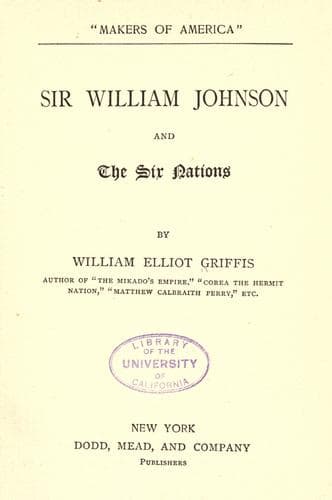
Sir William Johnson and the Six NationsGriffis, William Elliot
History
Sir William Johnson and the Six Nations
Griffis, William Elliot
Johnson, William, 1715-1774; United States -- History -- French and Indian War, 1754-1763
memorial of the great man who has stamped his name so ineffaceably on
the history of America.
In the neat village itself are many things to remind one of its founder.
The chief hotel is named after the baronet. A number of autograph
letters and relics are in possession of private persons. Documents in
the handwriting of Johnson are in the Masonic Lodge which he founded in
the parlour of Johnson Hall in 1772. The gold ring found in 1836 with
his dust, and inscribed with the date of an important event, and
possibly with the age of his bride, is here. Nor far away, the cradle of
black walnut in which Mollie Brant rocked her children is preserved as a
relic. In an old innkeeper’s book the first entry is that of the great
man’s name, who ordered the first glass of grog. Besides the evidences
of ordinary human life and infirmity, one cannot go very far in the
Mohawk Valley, or in those of the lowlands which hold the tributaries to
the river flowing through it, or in the collateral ones on higher
levels, but the fruits of a rich and busy life abound.
Johnson, though belonging to the Church of England, was willing to help
men who were of the Churches of Holland or of Germany. He assisted all
Christians to have houses of worship,—at Fort Hunter, Canajoharie,
Burnet’s Field, especially; but in other towns and villages tokens of
his presence are to be seen. He helped financially the Lutheran and
Reformed Germans, and the Dutch congregations, and provided the Indians
with missionaries and churches. With Domine Samuel Kirkland, who
laboured among the Iroquois for over forty years, and was the founder of
the town of Kirkland and of Hamilton College, Johnson was on friendly
and sympathetic terms. He greatly honoured the young man’s character,
and appreciated his labours; and the two frequently corresponded. During
one winter while secluded in Cherry Valley, Kirkland was saved from
starvation by the Indians, who gathered ginseng, for which they bought
provisions in Albany. The root having been just discovered on this
continent by a French Jesuit in Vermont, early in the century, already
formed one of the staples of American commerce with China.
While it is absurd to say that Johnson first “discovered” the fertility
of the Mohawk Valley, it is unquestionably true that he greatly
stimulated advance in agriculture. Under his encouragement many of the
Mohawk Indians became happy and prosperous farmers. When the officers
and men under the leadership of Sullivan, the New Hampshire general of
Irish descent, invaded the country of the Six Nations in 1778, they were
amazed at the evidences of Indian thrift, and at the wide areas of
richly cultivated land.
Public-domain text, read in full here on John Shaqi.
Reviews
Reviews
No reviews yet
Be the first to share your thoughts on this work.
Elsewhere in the archive
Join the Discussion
Join the discussion
Sign in to leave a comment or review.
Sign InorCreate an account