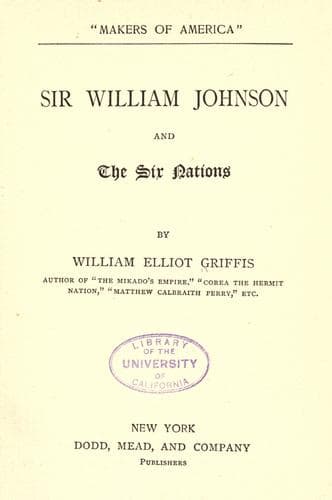
Sir William Johnson and the Six NationsGriffis, William Elliot
History
Sir William Johnson and the Six Nations
Griffis, William Elliot
Johnson, William, 1715-1774; United States -- History -- French and Indian War, 1754-1763
These being the piping times of peace, Johnson built a handsome
summer-house at Broadalbin, in Fulton County, where he entertained
lavishly. Having a healthy interest equal to that of the Englishman in
out-door sports, he also erected on the south bank of the Sacandaga
Creek a lodge, which has given the place the name it still holds,—the
Fish House. The building, which was of wood painted white, with the
doors and mouldings painted green, was comfortably furnished. It was
frequently occupied in summer, often with gay company from New York or
Albany. An orchard, vegetable-garden, well of spring water, sheds for
horses and cattle, with poultry and stock, enabled the lord of Johnson
Hall, with the assistance of his favourite negro slaves from the Manor,
to dispense lavish hospitality to his friends from Albany, Schenectady,
the Valley settlements, or even from Manhattan Island. Coming himself on
such occasions, in his later years, in a coach and six, it was no
infrequent sight to see the like equipages numerous in the grounds of
the Fish House. For days together, gayety and bustle filled the grounds,
while pleasure-parties of both sexes in the boats tempted to their hooks
the finny spoil. Excellent gunning was also provided in autumn for the
gentlemen in the sunken lands and low-lying coves along the Sacandaga,
wild ducks and geese being the chief game. Oftener, however, instead of
visiting Europeans or fashionable society nearer home, the baronet would
be accompanied by his cultured Irish friend and family physician, Dr.
Patrick Daly, and by his favourite musician, Billy. Nor is it likely
that tradition wrongs him in frequently furnishing him with other
room-mates, since chastity was not the shining virtue of Sir William
Johnson.
Simms, the gossipy annalist of Schoharie, who seemed incapable of
writing history or holding himself to a narrative without meandering off
into theology, politics, or preaching, has much to say about Sir William
Johnson. Though gathering a valuable harvest, his sheaves need to be
well threshed out before using. He has set down in sober print much
tittle-tattle which New England historians, as usual when writing about
New York, have only too freely copied.
Public-domain text, read in full here on John Shaqi.
Reviews
Reviews
No reviews yet
Be the first to share your thoughts on this work.
Elsewhere in the archive
Join the Discussion
Join the discussion
Sign in to leave a comment or review.
Sign InorCreate an account