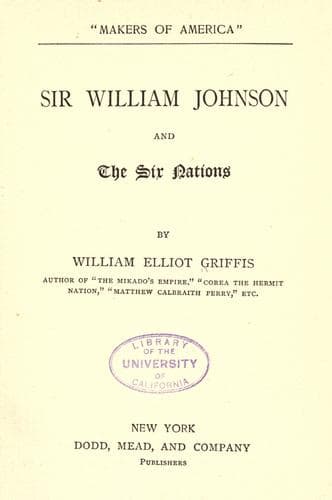
Sir William Johnson and the Six NationsGriffis, William Elliot
History
Sir William Johnson and the Six Nations
Griffis, William Elliot
Johnson, William, 1715-1774; United States -- History -- French and Indian War, 1754-1763
So rebellious a spirit as that manifested in New York must be rebuked,
and so the king and his counsellors chose as the proper man to curb it,
the infamous William Tryon. This Irishman had been an army officer, but
through his wife’s influence obtained the post of lieutenant-governor of
North Carolina in 1764; becoming governor in 1765. He was the fit tool
of the kind of a king and parliament that ruled England at this time.
Living while at Newbern, N. C., in amazing luxury, at the cost of the
oppressively taxed colonists, he delighted in scorning their
remonstrances and in crushing out their liberties. Goaded to
desperation, the Sons of Liberty, after five years of vain petition for
redress, met to the number of nearly two thousand on the banks of the
Alamance River. Tryon marched out from his “palace” with an army of one
thousand regular British troops, infantry, cavalry, and artillery, to
suppress them. On the 15th of May, 1771, the Regulators, or Sons of
Liberty, sent Tryon a message offering to lay down their arms if he
would redress their grievances. Tryon advanced with the idea of
scattering the patriots before the reinforcements coming from all parts
of the province should encourage the Regulators. When within a hundred
yards of the patriot ranks, his officers read the riot act. It was met
by shouts of defiance. Tryon then ordered his men to fire. They
hesitated. Rising in his stirrups, Tryon in a rage cried out, “Fire—on
them, or on me,” at the same time discharging his pistol and felling a
victim. In the two hours’ musketry battle which ensued, the ammunition
of the poorly armed patriots being soon exhausted, the decisive victory
of Tryon was obtained when the artillery was ordered up, and the unequal
contest decided by rounds of grape and canister. Twenty of the Sons of
Liberty were left dead on the field, the wounded being carried off. Of
Tryon’s men, sixty were killed or wounded.
Although practically unknown to popular American history, this was the
first battle of the American Revolution. For a few weeks Tryon held high
revel of execution and devastation in North Carolina, and was then, in
the height of his glory, transferred to New York; the Earl of Dunmore,
who from Oct. 18, 1770, had served for a few months on Manhattan Island,
being ordered to Virginia.
Public-domain text, read in full here on John Shaqi.
Reviews
Reviews
No reviews yet
Be the first to share your thoughts on this work.
Elsewhere in the archive
Join the Discussion
Join the discussion
Sign in to leave a comment or review.
Sign InorCreate an account