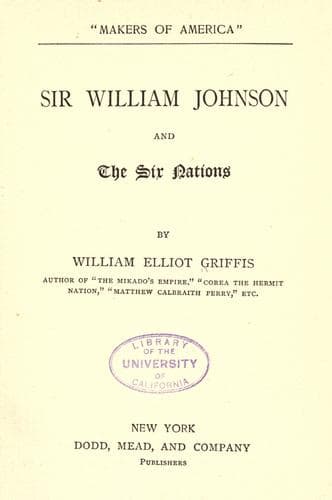
Sir William Johnson and the Six NationsGriffis, William Elliot
History
Sir William Johnson and the Six Nations
Griffis, William Elliot
Johnson, William, 1715-1774; United States -- History -- French and Indian War, 1754-1763
The citizens were now thoroughly roused, and on the 18th a riot broke
out, in which clubs and cutlasses were used, and in which the soldiers
were worsted; though several citizens were wounded, and one of them, a
sailor, died. When at Golden Hill, or John Street, between Cliff Street
and Burling Slip, the riot was stopped by the arrival of British
officers, who ordered their men back to camp. Conspicuous in the affrays
of next day were the sailors, who in revenge for the death of their
comrade clubbed the soldiers and drove them out of the streets into
their barracks. On the 5th of February a new liberty-pole was erected on
ground purchased for the purpose, and it remained until 1776.
The Sons of Liberty succeeded in carrying out the non-importation act so
vigourously that the market became empty of goods used as presents to
the Indians. Johnson was in danger of becoming seriously embarrassed.
The Cherokees, who in January, 1770, intended to go to war with the
tribes in the West and Southwest, wanted the Six Nations to join them.
These at once resolved first to ask the advice of Johnson, who appointed
a council at German Flats, hoping to win the Cherokees away from their
purpose. Johnson was obliged to write to the chairman of the Sons of
Liberty to get permission to receive or purchase a package invoiced to
him which they held in bond, promising to use the goods only for the
Indians. The request was cheerfully granted, and the goods delivered.
In company with Dr. Shuckburgh, who composed or introduced the tune of
“Yankee Doodle,” Johnson met the Indians, half famished as they were on
account of the failure of crops through caterpillars. The result of the
council was that the Cherokees gave up their proposed war, and the
treaty of Fort Stanwix was ratified in detail.
Perhaps it was from this incident that the New Yorkers prepared to dress
themselves as Mohawk Indians, and tumble the tea into the waters of the
East River, when it should come. On the 9th of July, hearing that all
taxes, except upon tea, had been removed, the Committee of One Hundred
agreed to receive all imports except tea. Johnson’s storehouses were now
well stocked with imported Indian goods. Indian trade, which had come
almost to a standstill, was resumed, much to the joy of all the Six
Nations. The red men could not comprehend the white man’s politics, or
realize that the love of money was the root of the evil of war also.
They could not understand that titles of nobility, commissions in the
army, stars, garters, decorations, and things most noble were peddled by
government and purchased by money.
Public-domain text, read in full here on John Shaqi.
Reviews
Reviews
No reviews yet
Be the first to share your thoughts on this work.
Elsewhere in the archive
Join the Discussion
Join the discussion
Sign in to leave a comment or review.
Sign InorCreate an account