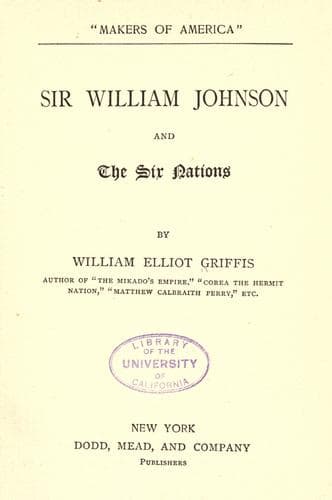
Sir William Johnson and the Six NationsGriffis, William Elliot
History
Sir William Johnson and the Six Nations
Griffis, William Elliot
Johnson, William, 1715-1774; United States -- History -- French and Indian War, 1754-1763
Remaining at home, he entertained at the Hall, in July, Governor Tryon
and his wife. Tryon, as avaricious as he was murderous, had come into
the Valley under pretence of holding a council with the Indians to
redress their grievances against Klock and others. In reality his
purpose was speculation in land; and the use of his office, like that of
so many royal governors of New York, was to swell his private purse,
while taking advantage of his high position. Although the Indians
rehearsed their troubles, and Tryon listened, they obtained from the
governor, who was too busy with his money-making schemes, no
satisfaction. After reviewing the militia at Johnstown, Burnet’s Field,
and German Flats, fourteen hundred men in all, and purchasing a large
tract of land north of the Mohawk, Tryon returned to New York. His name
was not suffered to remain on the map of New York; for Tryon County
before many years became one of the first of the nineteen counties in
the United States named after General Montgomery. Shortly afterward
Tryon appointed Johnson major-general of the Northern Department.
At a council with the chief sachems of the Confederacy of the Six
Nations held at his house, at the order of Lord Dartmouth, Johnson
obtained from them their assent to the purchase of twenty-three thousand
acres north of the Ohio, by the Ohio Company. After telling the chiefs
that as a mark of the king’s friendship to them Fort Pitt was to be
demolished, the sachems agreed to the settlement of what grew to be the
State of Ohio.
Public-domain text, read in full here on John Shaqi.
Reviews
Reviews
No reviews yet
Be the first to share your thoughts on this work.
Elsewhere in the archive
Join the Discussion
Join the discussion
Sign in to leave a comment or review.
Sign InorCreate an account