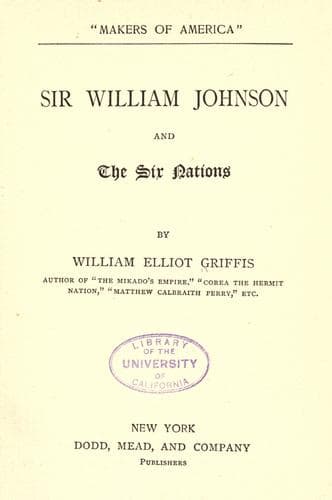
Sir William Johnson and the Six NationsGriffis, William Elliot
History
Sir William Johnson and the Six Nations
Griffis, William Elliot
Johnson, William, 1715-1774; United States -- History -- French and Indian War, 1754-1763
Just at the time when Sir William Johnson was in the midst of the most
varied activities, and was the most popular and influential man in the
whole province of New York, his physical strength failed. For several
years the inroads upon his constitution had warned him to seek the rest
from labours and from social indulgence which seemed impossible to him.
For the last ten years before his death he had suffered at intervals
from dysentery, which often kept him an invalid in bed for weeks. During
these periods of weakness the unextracted bullet received at Lake George
in 1755 irritated his nerves, and made his wound very painful. Even when
recovered from the attacks of the disease which threatened to be
chronic, active exercise was frequently impossible for a long time
afterward. This suffering, though so grievous to himself, was
providentially turned to the advantage of millions. It was the occasion
of the revelation to the world of the health-giving waters of Saratoga
Springs. With a touching solicitude for his personal good, the Mohawks
had called his attention to the remedial value of the High Rock Spring,
to which they always turned aside in their wanderings or hunts eastward.
On the 22d of August, 1767, Sir William left the Hall, and was borne to
these springs by his devoted Mohawks. He travelled in a boat to
Schenectady, and on their shoulders in a litter to Saratoga. A halt over
night was made at Ballston Lake in the cabin of an Irishman named
Michael McDonald. Reaching the springs by way of the Indian trail next
day, his faithful bearers built a bark hut, and tenderly cared for him
during the five days he was able to spend there,—for pressing letters
soon called him home. The Adirondack air charged with ozone, and the
cleansing and healing waters greatly benefited him. After his return,
when this fact was known, others followed his example. Known for ages to
the aborigines, its line of fame went out through all the earth; and
gradually the evolution of the most famous watering-place in America
followed. It is noteworthy that a camp of the red men is still found at
Saratoga Springs.
Stone, in his biography of Johnson, calls attention to the coincidence
that while Johnson was recovering at Saratoga, Dieskau was dying at
Suresnes near Paris. Both had been leaders of the opposing forces, and
both had been wounded at Lake George twelve years before. Arriving on
the 4th of September, he was in time to hail his knighted son, John,
just home from Europe. Had the vital nerve of an electric cable thrilled
under the ocean, Johnson would have heard, four days later, of the
decease of his illustrious antagonist.
Public-domain text, read in full here on John Shaqi.
Reviews
Reviews
No reviews yet
Be the first to share your thoughts on this work.
Elsewhere in the archive
Join the Discussion
Join the discussion
Sign in to leave a comment or review.
Sign InorCreate an account