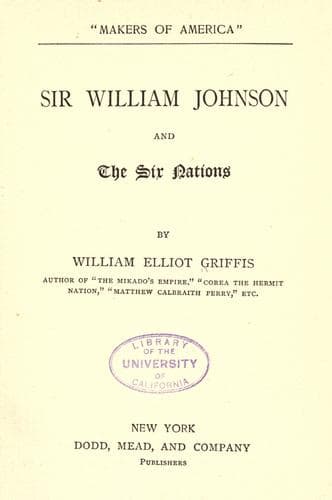
Sir William Johnson and the Six NationsGriffis, William Elliot
History
Sir William Johnson and the Six Nations
Griffis, William Elliot
Johnson, William, 1715-1774; United States -- History -- French and Indian War, 1754-1763
Other trips for the sake of health were made to the sea-shore at New
London, Conn.; but owing to the fact of his being so often overworked,
he was frequently prostrated in summer by his old enemy. When Cresap’s
war broke out in 1774, he was almost discouraged. Chief Logan’s
relatives—the Delaware chief Bald Eagle, and the Shawanese sachem
Silver Heels—had been murdered by white men, who were too eager to
improve red men off the face of the earth. The treaty of Fort Stanwix
had not only been trampled under foot by the whites, but the murderers
of Silver Heels had, perhaps unwittingly, but certainly in accordance
with Indian interpretation, committed a symbolical act which was not
private, but national and declarative. It meant war. After the white
murderer had shot Bald Eagle, who was alone on the river, he scalped the
chief, and propping his body upright in his canoe, sent him adrift down
the stream. No note of a congress or decree of a royal court could be to
the red man more distinctly a declaration of war than was the bloody
freight which this boat bore to the Indians.
To the Six Nations the murder of Logan, their kinsman, was a direct
insult and irritating challenge; yet instead of rushing to massacre,
they came to their friend Johnson to ask his counsel. For weeks before
the congress which he called to meet at his house, July 7, 1774, he was
in constant correspondence with his agents in the Ohio and Illinois
country. As fast as the chiefs arrived, he persuaded them privately to
refrain from war, and to trust in him to obtain justice. Six hundred
Indians, many of them from great distances, were impatiently waiting at
Johnson Hall while the war raged on the borders of Virginia. Though
Johnson was sick with dysentery, he took no thought of self. From a
sick-bed he rose to attend the council. After preliminaries, the meeting
on the 9th of July, 1774, was addressed by an eloquent Seneca chieftain.
Fortunately, God’s day of rest intervened; but on Monday—the last of
Johnson’s days on earth—his answer was given. For two hours, on a hot
day and in the glare of a July sun, with all his old-time fire of
eloquence, this friend of the red man spoke in grave discourse. His
diction was fiery, rhetorical, impassioned at times; but he spoke
judicially on the problem in hand, pleading that they should not rush
into war, but await the course of law. Six hundred dark faces, unrippled
with emotion, were fixed intently with burning but immovable eyes, and
with the gravity of statues, on the speaker during the long discourse.
Then after the peroration, pipes and tobacco were passed around, and the
conference broke up, that the auditors might prepare, through their
orator, a reply.
Johnson never heard the Indians’ rejoinder. A few minutes after the
conclusion he was taken with relapse. Supported to his library, he soon
became unconscious, and before sunset was dead.
Public-domain text, read in full here on John Shaqi.
Reviews
Reviews
No reviews yet
Be the first to share your thoughts on this work.
Elsewhere in the archive
Join the Discussion
Join the discussion
Sign in to leave a comment or review.
Sign InorCreate an account