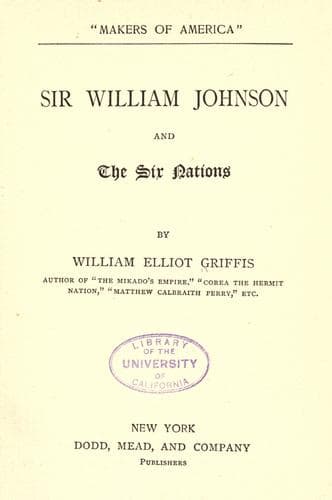
Sir William Johnson and the Six NationsGriffis, William Elliot
History
Sir William Johnson and the Six Nations
Griffis, William Elliot
Johnson, William, 1715-1774; United States -- History -- French and Indian War, 1754-1763
In the following pages no attempt at either laudation or depreciation
has been made. My purpose has been simply to set forth the actions,
influence, and personality of Sir William Johnson, to show the character
of the people by whom he was surrounded, and to describe and analyze the
political movements of his time. I confess I have not depicted New York
people in the sectional spirit and subjective manner in which they are
so often treated by New England writers. The narrow and purely local
view of some of these who have written what is called the history of the
United States, greatly vitiates their work in the eyes of those who do
not inherit their prejudices. Having no royal charter, the composite
people of New York, gathered from many nations, but instinct with the
principles of the free republic of Holland, were obliged to study
carefully the foundations of government and jurisprudence. It is true
that in the evolution of this Commonwealth the people were led by the
lawyers rather than by the clergy. Constantly resisting the invasions of
royal prerogative, they formed on an immutable basis of law and right
that Empire State which in its construction and general features is, of
all those in the Union, the most typically American. Its historical
precedents are not found in a monarchy, but in a republic. It is less
the fruit of English than of Teutonic civilization.
Living also but a few yards away from the home of Arendt Van Curler, the
“Brother Corlaer” of Indian tradition, and immediately alongside the
site of the old gate opening from the palisades into the Mohawk country,
I could from my study windows look daily upon the domain of the
Mohawks,—the places of treaties, ceremonies, and battles, of the
torture and burning of captives, and upon the old maize-lands, even yet
rich after the husbandry of centuries. Besides visiting many of the
sites of the Iroquois castles, I have again and again traversed the
scenes of Johnson’s exploits in Central New York, at Lake George, in
Eastern Pennsylvania, and other places mentioned in the text. With my
task is associated the remembrance of many pleasant outings as well as
meetings with local historians, antiquarians, and students of Indian
lore. I have treated more fully the earlier part of Johnson’s life which
is less known, and more briefly the events of the latter part which is
comparatively familiar to all. I trust I have not been unfair to the red
men while endeavouring to show the tremendous influence exerted over
them by Johnson; who, for this alone, deserves to be enrolled among the
Makers of America.
Public-domain text, read in full here on John Shaqi.
Reviews
Reviews
No reviews yet
Be the first to share your thoughts on this work.
Join the Discussion
Join the discussion
Sign in to leave a comment or review.
Sign InorCreate an account