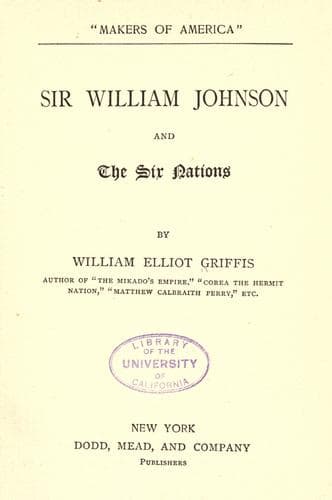
Sir William Johnson and the Six NationsGriffis, William Elliot
History
Sir William Johnson and the Six Nations
Griffis, William Elliot
Johnson, William, 1715-1774; United States -- History -- French and Indian War, 1754-1763
This point of time was shortly after the coming of Johnson, who thus
arrived at a lucky moment; and at once entering to reap where others had
sown, he became a man of the new era. He found the situation free for
his enterprise, which soon became apparently boundless. He cultivated
the friendship not only of the Indians, but of the white wood-runners,
trappers, and frontiersmen generally; and by his easy manners,
generosity, and strict integrity, bound both the red and the white men
to himself. He was a “hail-fellow-well-met” to this intelligent class of
men, and all through his wonderful career found in them a tremendous and
unfailing resource of power. Johnson laid the foundations of permanent
success, deep and broad, by the simple virtues of truth and honesty. He
disdained the meanness of the petty trader. His word was kept, whether
promise or threat. He refused to gain a temporary advantage by a
sacrifice of principle, and soon the poorest and humblest learned to
trust him. His word, even as a young man, soon became bond and law. The
Indians, who were never able to fathom diplomacy, could understand
simple truth. Two of the most significant gestures in the sign language
of the Indians are, when the index finger is laid upon the mouth and
moved straight forward, as the symbol of verity; and the same initial
gesture expresses with sinuosities, as of a writhing serpent, symbolical
of double dealing, prevarication or falsehood. The tongue of the
truth-speaker was thus shown to be as straight as an arrow, while that
of the liar was like a worm, or the crooked slime-line of a serpent. In
this simple, effective way Johnson’s business enlarged like his land
domains from year to year, while on knowledge of the Indians and their
language, and of the physical features of the Mohawks’ empire, he soon
became an authority. As early as 1743 he succeeded in opening a direct
avenue of trade with Oswego, doing a good business not only in furs, but
in supplying with provisions and other necessaries both the white
trappers and petty traders who made rendezvous at the fort. He was now
well known in Albany and New York, and soon opened correspondence with
the wealthy house of Sir William Baker & Co., of London, as well as with
firms in Atlantic seaports and the West Indies.
Public-domain text, read in full here on John Shaqi.
Reviews
Reviews
No reviews yet
Be the first to share your thoughts on this work.
Join the Discussion
Join the discussion
Sign in to leave a comment or review.
Sign InorCreate an account