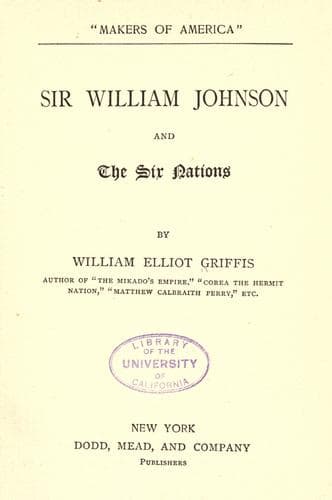
Sir William Johnson and the Six NationsGriffis, William Elliot
History
Sir William Johnson and the Six Nations
Griffis, William Elliot
Johnson, William, 1715-1774; United States -- History -- French and Indian War, 1754-1763
For over a century—from 1664 until 1783—the diplomatic, military, and
eleemosynary operations of British agents and armies among the Iroquois
were actively carried on. These were prolonged and costly, and had much
to do with making the enormous public debt of England, still unpaid. The
effect was to affect powerfully the imagination of the British public.
It was not merely the fiction of Cooper which created the tendency of
the Englishman just landed at Castle Garden to look for painted and
feathered Indians on Broadway. The author of “Leatherstocking” did but
stimulate the imagination already fed by the narratives of returned
veterans. Thousands of soldiers, who had heard the war-whoop in forest
battles, told their stories at British hearthstones until well into this
century. They, with Cooper, are responsible for the idea that forests
grow in Philadelphia. The fear still possessing English children that
American visitors, even of unmixed European blood, may turn red or
black, is one prompted by tradition as well as by literary fiction.
-----
[4] Letter to the writer, Feb. 7, 1890.
CHAPTER IV.
THE STRUGGLE FOR A CONTINENT.
FOR the possession of the North American continent two nations, France
and England, representing the two civilizations, Roman and Teutonic,
which dominate respectively Southern and Northern Europe, contended.
France, in America, embodied the Roman or more ancient type of
civilization, in which government and order were represented by the
priest and the soldier, while the people had little or nothing to do
with the government, except to obey. External authority was everything;
inward condition, little or nothing. The French system was not that of
real colonization, but of military possession; and the desired form of
social and political order was that based on monarchy and feudalism. In
the despotism of a Church subordinate to a ruler in Italy, and of a
State represented by a monarch, the individual was lost, and the
people’s function was simply to submit and pay taxes. They were taught
to look upon their privileges and enjoyments as the gifts of the
sovereign and of the Church. Authority emanated from the government,
which represented God, and represented Him infallibly.
The English colonists, whose leaders had been largely trained in the
Dutch Republic, represented the best elements of Teutonic civilization,
those of English blood being more English than the Englishmen left
behind, and more Teutonic than the Germans. Most of the principles and
institutions wrought out in the experience of the colonists, especially
those now seen to be most peculiarly American, were not of British, but
of continental origin. New England was settled mostly by immigrants who
had left England before 1640; and nearly all their leaders had come by
way of Holland, receiving their political and military education in the
United States of Holland, and under its red, white, and blue flag.
Public-domain text, read in full here on John Shaqi.
Reviews
Reviews
No reviews yet
Be the first to share your thoughts on this work.
Join the Discussion
Join the discussion
Sign in to leave a comment or review.
Sign InorCreate an account