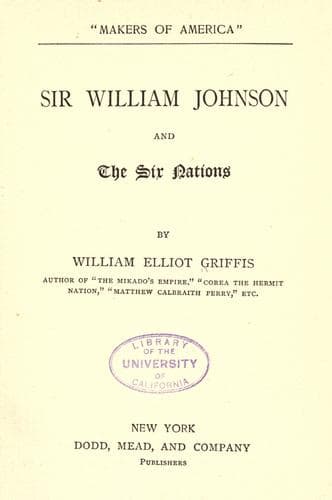
Sir William Johnson and the Six NationsGriffis, William Elliot
History
Sir William Johnson and the Six Nations
Griffis, William Elliot
Johnson, William, 1715-1774; United States -- History -- French and Indian War, 1754-1763
Meanwhile the white settlers were, according to Johnson’s report,
abandoning their farms along the Mohawk, and concentrating in the
block-houses or palisaded towns. Besides having sent Indian scouts to
the Champlain country, Johnson wrote urgent letters to Clinton stating
the case, and asking him to open his eyes to the facts. To protect
Johnson’s stores of eleven thousand bushels of grain, while standing his
ground, the governor sent a lieutenant and thirty men. Another militia
company was despatched to the upper Mohawk Castle. Having done these
things, Clinton, who had as early as the 4th of August officially
notified Governor Shirley of Massachusetts that he would proceed against
Crown Point with the warriors of the Five Nations, was at his wits’ end.
He had alienated Colonel Schuyler and the members of the Board of Indian
Commissioners, mostly faithful and trusted men well known in the
provinces. In the quarrel of the governor with De Lancey, these ranged
themselves on the side of the chief justice.
It is too clumsy an attempt at explanation of the difficulty between the
king’s agent, Clinton, and the Board of Indian Commissioners, to ascribe
the causes chiefly or entirely to the “rascality” of the commissioners,
who “abused their office for private peculation,” or to the ambition of
De Lancey. It is not necessary in one who appreciates the great
abilities of Johnson to describe him as a white lily of honesty and
purity. English authors, the Tory historians of the Revolution, and the
prejudiced writers of American history, who reflect their own narrowness
and sectional views, take delight in maligning the character of the men
of colonial New York simply because they were Dutch. As matter of
unsentimental fact, there is much to be said on both sides. The people
of New York were not anxious to send the Indians on the war-path, nor to
furnish white soldiers to guard their squaws and pappooses while they
were away from their villages. They were not at all persuaded of the
superior honesty either of the governor or his advisers and appointees.
The greater facts are also clear, that the New York Assembly was
vigilantly jealous of the people’s liberties, and was determined at all
hazards to limit the royal prerogative as far as possible. Since his
quarrel with De Lancey, the governor had shown excessive zeal in
maintaining the rights of the king. On the other hand, most of the steps
necessary to make New York an independent state had, as the British
Attorney-General Bradley declared, already been taken by his Assembly,
which of twenty-seven members had fourteen of Dutch descent. These men
were determined to teach the king’s agent that he must bow to the will
of the people, who were more important than king and court, and make no
advance in monarchical ideas. They saw that the governor was under the
close personal influence of Cadwallader Colden, a radical Tory, who they
suspected prepared most of Clinton’s State papers; and they set
Public-domain text, read in full here on John Shaqi.
Reviews
Reviews
No reviews yet
Be the first to share your thoughts on this work.
Join the Discussion
Join the discussion
Sign in to leave a comment or review.
Sign InorCreate an account