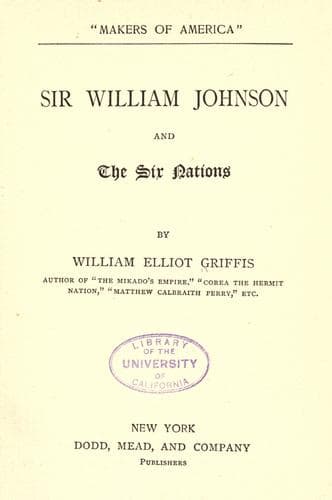
Sir William Johnson and the Six NationsGriffis, William Elliot
History
Sir William Johnson and the Six Nations
Griffis, William Elliot
Johnson, William, 1715-1774; United States -- History -- French and Indian War, 1754-1763
What the loss of the Indians was in this battle, as in most others, the
white men were never able to find out. Except at the scene of the first
firing and ambuscade, Indian corpses were not visible. The first purpose
of the redskins, as soon as the opening fury of battle slackened, was to
conceal their loss. To run out from cover, even in the face of the fire,
and draw away the corpses of their friends, was their usual habit, and
to this they were thoroughly trained. Exposure in such work was more
cheerfully borne than in regular combat, though usually the dead body
was reached by cautious approach, and with as much concealment as
possible in the undergrowth. A noose at the end of a rope was skilfully
thrown over the head of the corpse, and the end of the rope carried back
into cover. As skilfully as a band of medical students or
resurrectionists can put a hook under the chin of a corpse and hoist it
up from under the coffin-lid half sawed off, the savages in ambush would
draw the body of their fallen comrade out of sight, to be quickly
concealed or buried. Indian fighters often told stories of dead men
apparently turning into snakes and gliding out of sight. Owing to this
habit of the Indians, it was very difficult to arrive at the exact
execution done by the white man’s fire. As most of the Schenectady men
were trained Indian fighters, the loss of the savages was probably
great.
This was a sad day for Schenectady. One third of the white force engaged
were dead or wounded. Twenty corpses—twelve of them Schenectady
fathers, sons, or brothers, and eight Connecticut men—were laid on the
floor of a barn, near the church, which is still standing. The sorrowing
wives, mothers, and sisters came to identify the scalped and maimed dear
ones. Thirteen or fourteen men were missing, while the number of wounded
was never accurately known. In the Green Street burying-ground, east of
the “Old Queen’s Fort,” the long funeral procession followed the
corpses, while Domine Van Santvoord committed dust to dust.
Public-domain text, read in full here on John Shaqi.
Reviews
Reviews
No reviews yet
Be the first to share your thoughts on this work.
Elsewhere in the archive
Join the Discussion
Join the discussion
Sign in to leave a comment or review.
Sign InorCreate an account