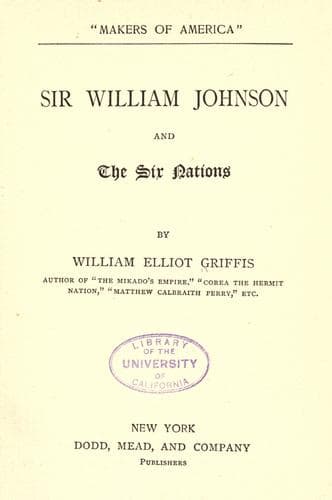
Sir William Johnson and the Six NationsGriffis, William Elliot
History
Sir William Johnson and the Six Nations
Griffis, William Elliot
Johnson, William, 1715-1774; United States -- History -- French and Indian War, 1754-1763
Many are the touching traditions of sorrow connected with this
“Beukendal massacre.” So it, indeed, appeared to the people of
Schenectady, because of so many of their prominent men thus suddenly
slain. To them it was in some sense a repetition of the awful night of
Feb. 8, 1690. Yet, instead of its being a massacre, it was a stand-up,
hand-to-hand fight in Indian fashion, and a typical border-battle. In
the superb and storied edifice of “The First Reformed Protestant Dutch
Church of Schenectady, in the county of Albany,”—so called in the old
charter given by King George II., and so rich in the graphic symbols of
“the church in the Netherlands under the Cross,” as well as of local
history,—a tablet epitomizing the history of the church in its five
edifices was set in its niche after the two hundredth anniversary of the
founding of the church, celebrated June 21, 1880. It is “in pitiful
remembrance of the martyrs who perished in the massacres of February
9th, 1690, and July 18th, 1748.” From the rear church window one may
still look, in 1891, on the barn on the floor of which the bodies were
brought and laid for identification on the day when the sturdy
Dutch-American Albert Van Slyck signed his letter to “Coll. William
Johnson at Albany,” “your Sorrowfull and Revengfull friend on those
Barbarous Enemys, and am at all Times on your Command.”
Clinton, accompanied by his satellite, Dr. Colden, and some other
members of his council, arrived in Albany, July 20. The next day, after
those necessary ceremonies to which the Indians are as great bond-slaves
as their civilized brethren, the council fairly opened. A great palaver
ensued, and talk flowed unceasingly for hour after hour, until many ears
needed rest even more than the few busy tongues. The governor wound up
his long address by referring to the battle of Beukendal, so recent and
so near by.
After three days of smoke and thought, a wordy warrior from Onondaga
replied for the Confederacy in prolix detail. The day was closed with a
dance by the young braves, and the king’s health was drunk in five
barrels of beer.
On the following day the River Indians spoke, expressing gratitude for
favours past, and asserting that if they had been present when news of
the Schenectady battle reached Albany, they would have cheerfully joined
in pursuit, even to the gate of Crown Point.
Public-domain text, read in full here on John Shaqi.
Reviews
Reviews
No reviews yet
Be the first to share your thoughts on this work.
Elsewhere in the archive
Join the Discussion
Join the discussion
Sign in to leave a comment or review.
Sign InorCreate an account