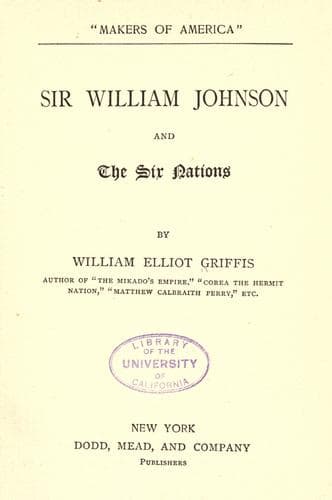
Sir William Johnson and the Six NationsGriffis, William Elliot
History
Sir William Johnson and the Six Nations
Griffis, William Elliot
Johnson, William, 1715-1774; United States -- History -- French and Indian War, 1754-1763
CHAPTER VII.
AT THE ANCIENT PLACE OF TREATIES.
THE OLD FRENCH WAR, or the War of the Austrian Succession, was foolishly
begun in Germany, and foolishly ended in Europe, Asia, and America. The
peace which came without honour settled nothing as regarded the
questions at issue in America. In reality this treaty guaranteed another
American war. Louisburg was again handed over to the French in exchange
for Madras. All prisoners in the three continents were to be released
without ransom, and a return of all conquered territory and property was
agreed to. The balance of power now rested level on its fulcrum, ready
for some fly’s weight to tilt it and cause the scale-pans to bounce.
In what part of the world first? With unspeakable disgust the raw troops
and scarred veterans, and the people generally of the colonies, received
the news. Not a few thought it was time to think of not only fighting
their own battles, but of making their own treaties. The continental or
American spirit, already a spark, was fanned almost to a flame.
Meanwhile, in home politics, New York was steadily advancing in the
pathway that was to merge into the highway of national independence. To
a New England writer, accustomed to the unbridled laudation of his own
State and ancestry as those who led the Teutonic-American colonies in
the struggle for liberty, the doings in the New York Assembly may seem
“teapot-tempest politics.” To those less prejudiced, it is a noble
chapter in the story of freedom, when they see an ultra-Tory British
governor fast relegated to a position of impotence, though backed by the
able Tory, Cadwallader Colden, while the people’s will is manifested in
persistent limitation of the royal prerogative.
This was the state of affairs in May, 1750, when, on the death of Philip
Livingston, Col. William Johnson was appointed to a seat in the
governor’s Executive Council. The Livingstones were sturdy men of
Scottish descent, descended from a Presbyterian minister who had been
banished for non-conformity. Like so many of the founders of America,
the Pilgrim Fathers and most of the chief settlers of Connecticut,
Massachusetts, Rhode Island, Pennsylvania, Virginia, the Carolinas, and
Georgia, he reinforced his democratic ideas by some years’ residence in
the Dutch Republic, living gladly under the red, white, and blue flag of
the United States of Holland. The Livingstones in America married into
families of Dutch descent, and thereby were still further imbued with
Republican ideas. Robert and Philip had been secretaries of Indian
affairs, and had thus gained great favour and influence over the
Iroquois. Of their descendants, one was a signer of the Declaration of
Independence, and others were officers in the Revolutionary army, while
others are even yet adorning the annals of freedom, progress, and order.
Public-domain text, read in full here on John Shaqi.
Reviews
Reviews
No reviews yet
Be the first to share your thoughts on this work.
Elsewhere in the archive
Join the Discussion
Join the discussion
Sign in to leave a comment or review.
Sign InorCreate an account