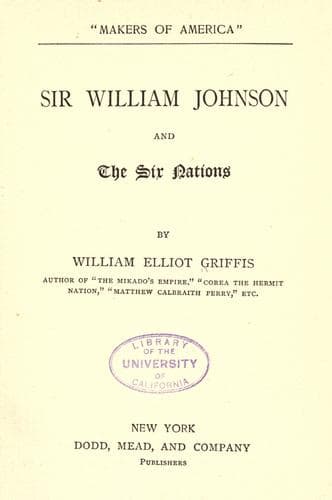
Sir William Johnson and the Six NationsGriffis, William Elliot
History
Sir William Johnson and the Six Nations
Griffis, William Elliot
Johnson, William, 1715-1774; United States -- History -- French and Indian War, 1754-1763
Clinton was, no doubt, very glad to have, in place of a Livingstone, one
who was so loyally devoted to the Crown, and so good a personal friend
as Johnson near him, Johnson, however, was not sworn in and seated until
1751.
The state of affairs was growing worse and worse, and Clinton the
foolish had attempted to stay the tide of democracy by having no
Assembly called for two years. When, however, it met on Sept. 4, 1750,
Johnson’s bills for six hundred and eighty-six pounds, for provisions
sent to Oswego, were cheerfully paid; but the vote was so made that the
governor’s claims were, as he thought, invaded. However, for good
reasons, and fearing the loss of trade, he submitted. Could Johnson’s
invaluable services have been acknowledged without also making
recognition of Clinton’s pretensions, the Assembly would have been more
liberal. The remarks and strictures of the biographer and eulogist of
Johnson about the Dutch traders of Albany, and “the love of gain so
characteristic of that nation” (_sic_) seem strange when the same love
of gain was, and is, equally characteristic of Englishman, Yankee,
Scotsman, Huguenot, and Quaker. No one will justify the members of the
New York Colonial Assembly in all their acts, especially those which
were clearly contemptible; but we cannot see that Johnson, Clinton, or
the English loved either lucre or liquor any less than the Albany
Dutchmen. Indeed, it was the well-founded suspicion that Clinton was
using his office largely to recoup his broken fortunes that made the
representatives resist him at every point. Johnson, however, finding
that the Assembly and the governor could never be reconciled, and that
his first bill of two thousand pounds would be likely, under existing
circumstances, to remain unpaid, resigned his office of Superintendent
of Indian Affairs. To his Iroquois friends he announced this step by
sending wampum belts to all the chief fortified towns of the
Confederacy.
Neither war nor peace had settled the question of the boundary lines
between the French and English possessions in America. The French
claimed the Ohio and Mississippi Valleys by right of prior discovery by
La Salle and others. The English based their ownership on occupation by
the Iroquois or their vassals, and because the Five Nations were allies
of Great Britain. Both parties now began anew to occupy the land. The
race was westward through the Ohio Valley to the Mississippi. The
starting-points were from tidewater Virginia and from Montreal. Not on
parallel lines, but toward the apex of a triangle, and straight toward
collision, the movement began. The Ohio Company was formed with a grant
of six hundred thousand acres by the English Government, chiefly to
speculators in Virginia. George Washington was one of the first to be
smitten with the fever of speculation, and to the end of his days he
made investments in the Western lands as eagerly as many do now in
Western farm mortgages.
Public-domain text, read in full here on John Shaqi.
Reviews
Reviews
No reviews yet
Be the first to share your thoughts on this work.
Elsewhere in the archive
Join the Discussion
Join the discussion
Sign in to leave a comment or review.
Sign InorCreate an account