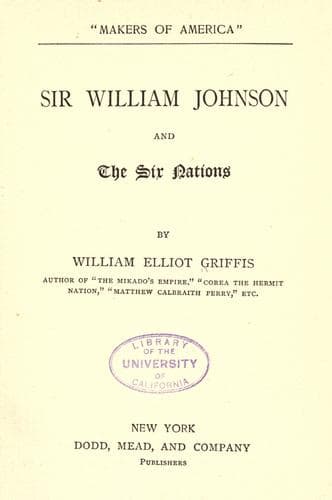
Sir William Johnson and the Six NationsGriffis, William Elliot
History
Sir William Johnson and the Six Nations
Griffis, William Elliot
Johnson, William, 1715-1774; United States -- History -- French and Indian War, 1754-1763
Francis Picquet, priest, soldier, and statesman, saw the necessity of
securing the loyalty of the Six Nations; and receiving the French
Governor’s assent, established himself at La Presentation, on the St.
Lawrence River, between Oswego and Montreal, a fort and a chapel.
Ostensibly his mission was the conversion of the Iroquois. No more
strategic point could have been selected. Whether for peace, war, trade,
voyaging, or education and general influence, the site was supremely
appropriate. When Johnson heard of the man called, according to which
side of the border his name was spoken, “Apostle of the Iroquois” or
“Jesuit of the West,” he was alarmed, especially when he learned that
this lively hornet, Joncaire, was busy in fomenting trouble among the
tribes in the valleys of the Ohio and Mississippi. Before long, this
Jean Cœur had succeeded in reviving between the Iroquois and western
tribes and the Catawbas an old feud. Very soon Clinton received word
from Gov. James Glenn, of South Carolina, that the Senecas were on the
war-path and murdering the Catawbas. In this action the Senecas were
repeating one of the numerous southern raids to which their grandfathers
had been addicted, and one of which Col. John Washington, ancestor of
George, assisted to repel. At Johnson’s suggestion, Clinton now invited
all the tribes composing the Confederacy or in alliance with the
Iroquois to meet at the ancient place of treaties,—the ground on which
now stands the new Capitol at Albany,—while Clinton himself called upon
the governors of all the colonies to form a plan of union for uniting
the tribes and resisting French aggression. On the 28th of June, 1751,
the tribes met in Albany, again to renew the covenant first confirmed by
Arendt Van Curler. There were present delegates from Connecticut,
Massachusetts, and South Carolina, and Indians from the Great Lakes,
besides six Catawba chiefs and representatives of the Six Nations.
The first point made by the Iroquois was that Colonel Johnson should be
reappointed Superintendent of Indian Affairs. They begged leave to try
to influence him by sending a string of wampum to him at Mount Johnson.
They despatched a swift footman to his house. A man is a finer animal
than a horse, and, in the long run, swifter and more enduring. They
chose two human soles rather than four horse’s hoofs for their
messenger. Johnson met the wampum-bearer at Schenectady; but when at
Albany, despite the eloquence of Clinton and the Indians, he firmly
declined serving again while his salary depended upon the Assembly. He
now took the oath of office and his seat in the governor’s Council. He
retained this dignity while he lived.
Public-domain text, read in full here on John Shaqi.
Reviews
Reviews
No reviews yet
Be the first to share your thoughts on this work.
Elsewhere in the archive
Join the Discussion
Join the discussion
Sign in to leave a comment or review.
Sign InorCreate an account