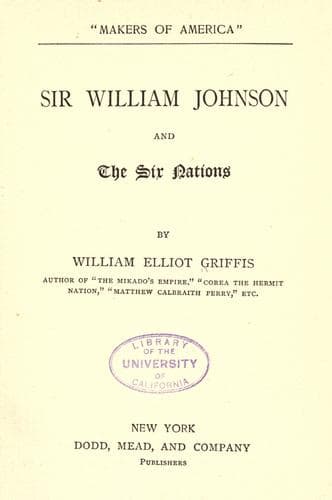
Sir William Johnson and the Six NationsGriffis, William Elliot
History
Sir William Johnson and the Six Nations
Griffis, William Elliot
Johnson, William, 1715-1774; United States -- History -- French and Indian War, 1754-1763
The great council formally opened on the 6th of July, 1751. Besides the
usual eloquence there was much singing, with ceremonial dances and
enjoyment of that aboriginal custom and product,—the pipe and tobacco.
The sucking and actual whiffing of the calumet, the metaphorical burying
of the hatchet and planting of the tree of peace, signified that war was
over between the Southern and Northern Indians. The confederates living
above the not yet made Mason’s and Dixon’s line clasped hands across the
bloody chasm with the Southerners, and peace again reigned from Pilgrim
Land to the Salzburger Germans in Ogelthorpe’s country. The “late
unpleasantness” was past. After the usual drinking of fire-water and
distribution of presents, the council adjourned, and the Indians went
home.
While the Pennsylvania traders were establishing posts on the Ohio,
under British authority, the French were also busy. Early in September,
from a French deserter, Johnson learned the startling news that a great
fleet of canoes manned by twelve hundred Frenchmen and two hundred
Adirondack Indians, had passed Oswego, bound for the Ohio. News also
arrived by a Cayuga chief that at Cadaracqui a large French man-of-war
was being built for the reduction of Oswego. This fort was then in
command of Lieutenant Lindsay, founder of the Scottish settlement at
Cherry Valley.
Johnson was in New York attending to his duties as a member of the
Council, when the harassing news was received. In addition to the
anxiety this caused him, he was selected by Clinton to do what proved to
be a disagreeable task to himself, and in the eyes of the people’s
representative a repulsive one. Indeed it seemed to them to be doing the
governor’s dirty work. When the House sent to the Council an act for
paying several demands upon the colony, it pleased Clinton and the
Council to demand vouchers, and Johnson was sent to the Assembly to
request them. The offended and angry representatives of the people
declared that the demand was extraordinary and unprecedented, and
declined to consider the request until the first of May. The Council,
angry in turn, sent Johnson back with a bill of their own
originating,—in clear violation of right precedent and propriety,
“applying the sum of five hundred pounds for the management of Indian
affairs and for repairing the garrison at Oswego.”
Public-domain text, read in full here on John Shaqi.
Reviews
Reviews
No reviews yet
Be the first to share your thoughts on this work.
Elsewhere in the archive
Join the Discussion
Join the discussion
Sign in to leave a comment or review.
Sign InorCreate an account