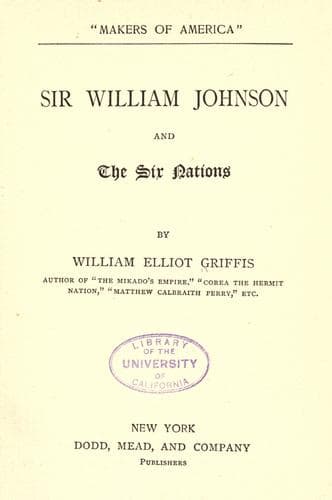
Sir William Johnson and the Six NationsGriffis, William Elliot
History
Sir William Johnson and the Six Nations
Griffis, William Elliot
Johnson, William, 1715-1774; United States -- History -- French and Indian War, 1754-1763
Parkman’s magic pen has drawn the picture of the movements of Dieskau,
the German, and his French and Indian forces opposed to the provincial
army, and has brilliantly described the camp and forces at Lake George,
when, on the morning of Sept. 8, 1755, the Canadians, Indians, and
French, numbering fifteen hundred, being, unknown to the English, only
an hour’s march distant, one thousand men sallied out from the camp to
capture Dieskau and his forces. The spirit of Braddock seemed to be
still in the air; and the men—New England and New York militia—sallied
out jauntily, expecting easy victory, but in reality to what proved “the
bloody morning scout.” They were led by Col. Ephraim Williams—whose
will, creating what is now Williams College, had been made a few days
before at Albany—and by Lieutenant-Colonel Whiting. In three divisions
the little army marched out and soon disappeared from view in the
forest, just before nine o’clock A. M. The two columns, French and
English, were thus approaching each other in a narrow road, like trains
on a single track in a tunnel.
Not knowing what the issue might be, Johnson made preparation for all
risks. He at once ordered trees felled and laid lengthwise. With these
and the wagons, bateaux, and camp equipage, he constructed a rough line
of defence, which faced all along the one side of the camp which an
assaulting party might be reasonably expected to attack,—that is, on
that side of the rough quadrangle which was parallel to the lake. At
that portion fronting the road, he planted three of his heaviest pieces
of cannon, one thirty-two and two eighteen-pounders. Another was posted
a little way round to the left, while five howitzers of smaller calibre,
with the mortars, one of thirteen-inch, and four of smaller calibre,
were stationed to throw shell in the morasses and woods on the flanks.
The superb artillerist, Major William Eyre, with a company of British
sailors, served the guns.
The situation then was as follows: Colonel Williams’s party was marching
southward along the stump-embossed road cut by Johnson’s axemen a few
days before. After advancing two miles he halted for the other divisions
to come up, and then moved in a solid body. With what seems incredible
carelessness, neglecting to send out scouts, they moved on,
Braddock-like, unsuspicious of danger, imagining that the French were
miles away.
On the contrary, Dieskau’s scouts had watched their departure from the
camp, and quickly reported the news to the German baron. He at once
ordered his regulars to halt, and sent the Canadians and Indians into
the forest, three hundred paces ahead, with orders to lie flat on the
ground behind trees, rocks, and bushes, and make no noise or sign until
the regulars had fired, when all were to rise and surround the English.
Public-domain text, read in full here on John Shaqi.
Reviews
Reviews
No reviews yet
Be the first to share your thoughts on this work.
Elsewhere in the archive
Join the Discussion
Join the discussion
Sign in to leave a comment or review.
Sign InorCreate an account