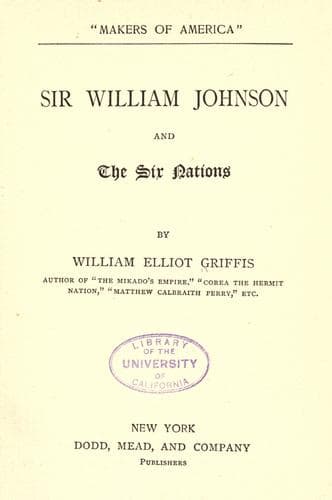
Sir William Johnson and the Six NationsGriffis, William Elliot
History
Sir William Johnson and the Six Nations
Griffis, William Elliot
Johnson, William, 1715-1774; United States -- History -- French and Indian War, 1754-1763
BY THE MOVEMENTS in Western Pennsylvania, the war had already broken
out, though the diplomatists on the transatlantic side had not yet said
so. By the first week in May, the raids on the northern border began by
the destruction of Hoosic, within ten miles of Fort Massachusetts. The
half-naked or starving refugees reaching Albany furnished a vivid
object-lesson of reality. Under Johnson’s vigilance and activity, the
people in the forts, block-houses, and palisaded villages were kept on
guard night and day. In this work he was ably seconded by Governor De
Lancey. Politics make strange bed-fellows; and the late critic and
opponent, now that he occupied the seat of the person whom he had,
largely out of party spirit, opposed, became a warm friend of his friend
Johnson, the untiring frontiersman.
When in New York, Feb. 28, 1755, Johnson learned of the official
declaration of war, and the sailing from Cork, Ireland, of General
Braddock with one thousand regulars, bound for Alexandria, Va.; and to
this place Johnson with Governor De Lancey made a journey. At the
council held by the five royal governors, expeditions against Nova
Scotia, Crown Point, Niagara, and Fort Du Quesne were planned. Johnson
was again made Superintendent of Indian Affairs, and appointed as
major-general to command the forces for the reduction of Crown Point.
The story of the success of one of these expeditions and the failure of
two of them under Braddock and Shirley, is known to all. We may now
glance at that under Johnson. After a great council held in June,
attended by eleven hundred of all ages and sexes, to the devastation of
Johnson’s larder, King Hendrick and many hundred fighting men promised
to be ready for war. After various delays, the motley army gathered from
the colonies left Albany August 8, 1755, and on the 28th Johnson reached
the Lake of the Holy Sacrament. A true courtier, he changed the name
given by Isaac Jogues, which had superseded the Indian term,
Andiatarocte; and in honour of his sovereign George, and “to ascertain
his undoubted right there,” called the beautiful water by the name it
still bears. The modern fanciful name “Horicon” seems to be nothing more
than a printer’s mistake, glorified by a romancer.
Public-domain text, read in full here on John Shaqi.
Reviews
Reviews
No reviews yet
Be the first to share your thoughts on this work.
Elsewhere in the archive
Join the Discussion
Join the discussion
Sign in to leave a comment or review.
Sign InorCreate an account