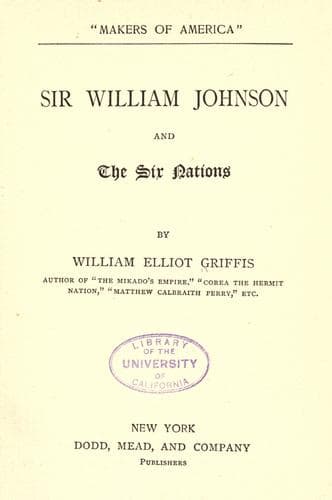
Sir William Johnson and the Six NationsGriffis, William Elliot
History
Sir William Johnson and the Six Nations
Griffis, William Elliot
Johnson, William, 1715-1774; United States -- History -- French and Indian War, 1754-1763
Three days after, the Iroquois allies waited on Johnson and informed him
that, according to custom, after losing comrades in battle, they must
return home to cheer their people, and protect their castles against the
Abenaki Indians, from whom they feared an attack. It was in vain that
Johnson tried to show them that the campaign had hardly begun, and to
persuade them to alter their purpose. They insisted on going away,
promising, however, to come again soon with fresh zeal.
Dissensions and jealousies between the troops of the various colonies
now broke out. Both the generals commanding, and the new governor,
Hardy, thought that a strong fort should be built to command the
water-way to Canada, by way of Lake George. Though as important for the
defence of New England as of New York, the Eastern officers and men
could not see the need of a fort here, and the work dragged. When
finished, it was called by the courtier, Johnson, Fort William Henry,
after the king’s grandson, and had a notable history. Meanwhile, owing
to remissness of contractors, the petty jealousies of the officers and
militia of five or more colonies, and the overcautiousness of Johnson,
nothing aggressive was done. Late in November, the fort being finished,
the unpopular duty of garrisoning it devolved upon a medley of six
hundred men from the various colonies. The army was disbanded, and the
levies marched home. Johnson resigned his commission, and returned to
Mount Johnson about the middle of December. About ten days later he was
in New York, enjoying, as well as his wound would allow, the parade and
illumination of the city in his honour; while Dieskau languished in the
Schuyler mansion in Albany, waiting for some of his many wounds to heal;
and Lyman received modest honours at home. The patent of Johnson’s
baronetcy was dated Nov. 27, 1755. He invested the four thousand nine
hundred and forty-five pounds eighteen shillings and sixpence which came
into his hands, in three per cent bank annuities.
His coat-of-arms consisted of a heart-shaped shield held and flanked on
either side by an Indian equipped with feathers, medal, quiver, and bow.
On the shield are three fleurs-de-lis; and on the convex band across the
shield, two shells, and between them a smaller heart, on which lies an
open hand supine. Above the shield a hand grasps a dart. The motto is
_Deo Regique Debeo_. The full inscription of the blazon in the language
of heraldry is given in the standard books which treat of the British
peerage.
CHAPTER IX.
BRITISH FAILURES PREPARING FOR AMERICAN INDEPENDENCE.
Public-domain text, read in full here on John Shaqi.
Reviews
Reviews
No reviews yet
Be the first to share your thoughts on this work.
Elsewhere in the archive
Join the Discussion
Join the discussion
Sign in to leave a comment or review.
Sign InorCreate an account