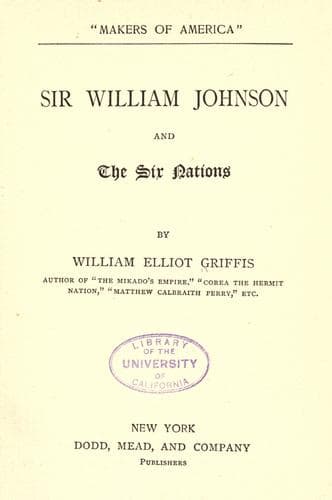
Sir William Johnson and the Six NationsGriffis, William Elliot
History
Sir William Johnson and the Six Nations
Griffis, William Elliot
Johnson, William, 1715-1774; United States -- History -- French and Indian War, 1754-1763
THE versatile Johnson, turning from military to civil duties, remained
in New York during the whole of the month of January, 1756. The men then
in control of the British government, with their usual obtuseness, sent
another sailor to do the work of a statesman. Sir Charles Hardy, after
appointing October 2 as a day of public thanksgiving for the victory at
Lake George, celebrated it himself by starting on a visit to Albany. He
proposed to effect such a resumption of active military operations as
would secure the main object of the great expedition,—the capture of
Crown Point. His presence, however, was fruitless, and he returned to
New York, November 26. Then, on the 2d of December, he met his little
Parliament, and told them all about the victory of General Johnson or
Baron Dieskau. The stolid Dutchmen and others were unable, as the Indian
orators would say, “to see it in that light.” They could not do other
than anticipate the verdict of the critical scholarship of this
generation, for they looked upon the whole affair as “a failure
disguised under an incidental success.” Further, instead of hearing that
the English flag waved over Crown Point, and that English cannon guarded
the narrows of Lake Champlain, they were asked to pay for Fort William
Henry and Fort George, both of which were but an ordinary day’s
horseback-ride from Albany. At the same time Sir Charles demanded in
King George’s name a permanent revenue, with which to pay governors,
judges, and the general expenses of the government.
To the first proposition, to pay their share of expense for forts in
which all the colonies were interested, the Assembly at once responded
favourably. To the second they gave a flat refusal, declaring that the
idea of a permanent revenue was in direct opposition to the public
sentiment of the colony.
On the same day on which the Assembly met, Governor Shirley arrived in
New York. Being, by the death of Braddock, the king’s chief military
representative in America, he summoned a congress of colonial governors
to meet in New York December 12. With his usual extraordinary mental
activity, he was full of schemes, one of which was a midwinter campaign
against Ticonderoga. The congress approved of it; but the hard-headed
members of the Assembly, the people generally, and Johnson, did not.
With all admiration for the fussy politician, who planned superbly on
paper, but somehow failed in the field, they had a sincere respect,
which was, however, tempered by excellent common-sense.
Public-domain text, read in full here on John Shaqi.
Reviews
Reviews
No reviews yet
Be the first to share your thoughts on this work.
Elsewhere in the archive
Join the Discussion
Join the discussion
Sign in to leave a comment or review.
Sign InorCreate an account