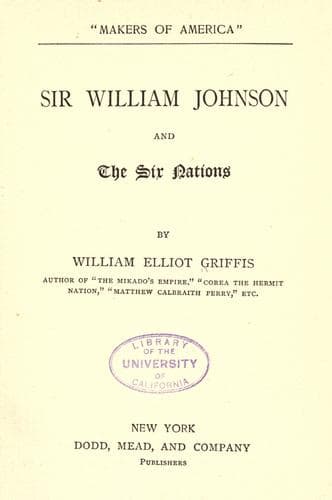
Sir William Johnson and the Six NationsGriffis, William Elliot
History
Sir William Johnson and the Six Nations
Griffis, William Elliot
Johnson, William, 1715-1774; United States -- History -- French and Indian War, 1754-1763
It is needless to say that the Assembly gained their point, and that the
greatest and most lasting victory of the people in the long story of
American liberty was won. A few months after, at the autumn session, the
joyful news reached New York that the Crown had virtually repealed the
instructions to Sir Danvers Osborne, which had made the colonists of New
York set themselves in united array of resistance to “their most
gracious sovereign.”
The war had thus far been carried on without profession or declaration.
The diplomatists of London and Versailles had been as polite and full of
smooth words as if profound peace reigned. The English were following
their old trade of piracy, and had captured hundreds of French vessels,
and imprisoned thousands of French sailors. The French, on the other
hand, were doing with England as they did with China in 1885, when they
bombarded cities, treacherously got behind forts in the Pearl River, and
killed thousands of Chinese, while all the time professing to be at
peace. At length the British went through the formality of declaring
war, May 17. On the French side, the necessary parchment, red tape, and
seals were prepared, and the official ink flowed two years after blood
had flowed like water.
Now at last, in Pitt, England had a premier who knew something about the
geography of America; and “geography,” as Von Moltke teaches, “is half
of war.” William Pitt thought the time had come for intelligent and
active operations looking to the conquest of North America by the
English. His first selection of men, however, was not particularly wise
or evident of genius. Listening to the word of Johnson, and others in
New York, he removed Shirley from the chief command, and sent out,
successively, Colonel Webb, General Abercrombie, and Lord Loudon,—all
of them, as it proved, failures.
Public-domain text, read in full here on John Shaqi.
Reviews
Reviews
No reviews yet
Be the first to share your thoughts on this work.
Elsewhere in the archive
Join the Discussion
Join the discussion
Sign in to leave a comment or review.
Sign InorCreate an account