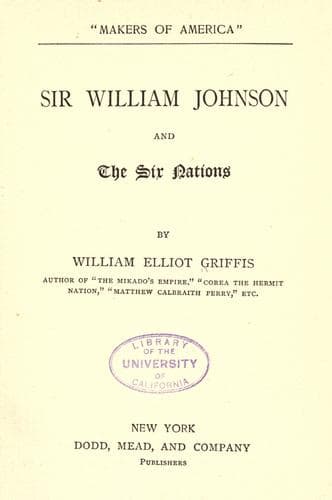
Sir William Johnson and the Six NationsGriffis, William Elliot
History
Sir William Johnson and the Six Nations
Griffis, William Elliot
Johnson, William, 1715-1774; United States -- History -- French and Indian War, 1754-1763
Yet strange as it may seem, the New York Assembly was slow in voting
supplies. The ultra-loyalists who supported Hardy, who was backed by the
king and his council, now vented their maledictions upon the
“foreigners” who made the cosmopolitan population of the province, and
their representatives in the Assembly. All this seems strange to the
average historiographer, especially to the copyist of loyalist or other
writers who rely on such men as Colden, Smith, Jones, Washington Irving,
and the like, for their ideas of Colonial New York and her people. There
was good reason for the stubbornness of the legislators. The fact is,
that the people of the province of New York were mostly descendants of
the sturdy Republicans who had fought under William the Silent. They
believed that the encroachments of monarchy—that is, one-man
power—were more dangerous than the raids of hostile Indians. The Dutch,
Germans, Scots, Irish, Huguenots, were almost a unit in their democratic
ideas. This province, unlike others of the original thirteen, was not
settled by people of aristocratic England, in which a republic, once
begun, had gone to pieces inside of twelve years, but by men long
trained in self-government and in a republic. Even their forms of church
life were as nurseries for the training of men in democratic principles.
To the loyalist historian, Jones, a Presbyterian seems to be a synonym
for rebel, of whatever name or strain of blood. Congregationalists, fed
on the rhetoric and oratory of Forefathers’ Day, find it hard to believe
that the democratic idea in Church and State flourished anywhere outside
of New England. The New York men were determined at all hazards—even
the hazards of savage desolation—to resist any further trenching upon
their rights by King George, or his subservient Parliament, or his
bullying governor.
England had sent over, after Clinton, another illiterate sailor to
enforce a fresh demand,—even the passage of a law for settling a
permanent revenue on a solid foundation; said law to be indefinite and
without limitation of time. The descendants of the Hollanders who had
long ago, even against mighty Spain, settled the principle of no
taxation without consent, and had maintained it in a war of eighty
years, were resolved to fight again the same battle on American soil.
They now set themselves resolutely to resist the demands of the Crown,
and this whether Indians were in Orange County or at Niagara. Despite
the protests of such incorrigible Tories as Smith, Colden, and others in
the Executive Council, the people’s representatives persevered.
Public-domain text, read in full here on John Shaqi.
Reviews
Reviews
No reviews yet
Be the first to share your thoughts on this work.
Elsewhere in the archive
Join the Discussion
Join the discussion
Sign in to leave a comment or review.
Sign InorCreate an account