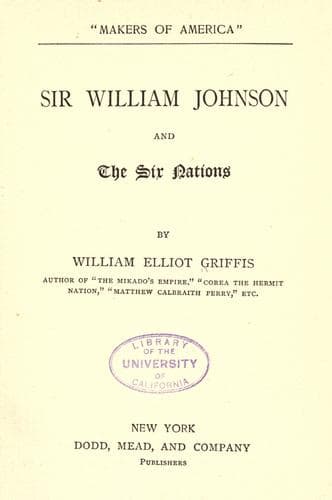
Sir William Johnson and the Six NationsGriffis, William Elliot
History
Sir William Johnson and the Six Nations
Griffis, William Elliot
Johnson, William, 1715-1774; United States -- History -- French and Indian War, 1754-1763
One of the good things done by Parliament at this time was the formation
of the Royal American Regiment of four battalions, each a thousand
strong. Of the fifty officers commissioned, nearly one third were
Germans and Swiss. Most of the rank and file were Palatine and
Swiss-Germans in America, who enlisted for three years. None of the
officers could rise above the rank of lieutenant-colonel, and the Earl
of Loudon was appointed first colonel-in-chief. Loudon was succeeded in
1757 by Abercrombie, and in 1758 by Lord Amherst. Until the
Revolutionary War, this cosmopolitan regiment did noble service under
Stanwix, Bouquet, Forbes, Prideaux, Wolfe, and Johnson. From 1757 to
1760 we find one or more battalions of the regiment in active service in
the various parts of New York. The famous Rev. Michael Schlatter, the
organizer of the German Reformed Church in Pennsylvania, was the
regimental chaplain. On the 15th of June, 1756, the forty German
officers who were to raise the recruits arrived, one of the ablest being
Colonel Bouquet. This Swiss officer, with the Germans, at Bushy Run in
Pennsylvania largely retrieved the disasters caused by Braddock’s
defeat, and restored the frontiers of Pennsylvania to comparative safety
and comfort.
While Abercrombie, who was one of those military men whose reliance is
less upon the sword than the spade, was digging ditches in Albany,
Johnson was arranging for a great Indian council at his house on the
Mohawk. He had in view the double purpose of winning the Delawares and
other Pennsylvania tribes from war against the English colonists, and of
inducing all the Northern Indians to join in the expedition against the
French posts on Lake Ontario. Braddock’s defeat had been the signal for
the Delawares, under the direct influence of the French, to break the
peace of more than seventy years, and to scatter fire and blood in
Pennsylvania, from the Monongahela to the Delaware. The solemn treaty of
Penn—which Voltaire, with more wit than truth, declared was “never
sworn to and never broken”—was now a thing of the past. The wampum was
unravelled, and the men with hats and the men with scalp-locks were in
deadly conflict. While the Friends remained at their Philadelphia
firesides, the German and Scotch settlers on the frontier bore the brunt
of savage fury. When public action was taken, it was in the double and
contradictory form of peace-belts of wampum sent by the Friends, and a
declaration of war by Governor Morris. In this mixed state of things it
was hard for Johnson to know what to do. Through his influence the
Iroquois, uncles and masters, had summoned by wampum belts their nephews
and vassals to the great conference which was opened at his house in
February, 1756. To prepare for this, Johnson had made a journey to the
council-fire of the Confederacy at Onondaga, arriving June 15. There he
succeeded in neutralizing in part the work done by the French, and
obtained an important concession.
Public-domain text, read in full here on John Shaqi.
Reviews
Reviews
No reviews yet
Be the first to share your thoughts on this work.
Elsewhere in the archive
Join the Discussion
Join the discussion
Sign in to leave a comment or review.
Sign InorCreate an account