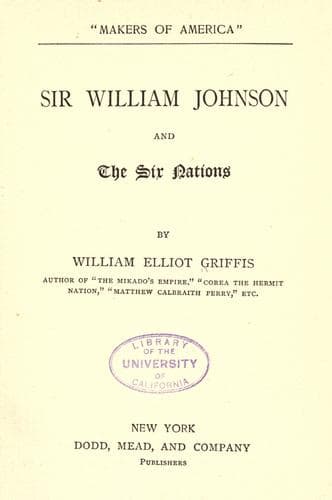
Sir William Johnson and the Six NationsGriffis, William Elliot
History
Sir William Johnson and the Six Nations
Griffis, William Elliot
Johnson, William, 1715-1774; United States -- History -- French and Indian War, 1754-1763
The Iroquois voted to allow a road to
be opened through the very heart of their empire to Oswego, and a fort
to be built at Oswego Falls.
These severe exertions cost Johnson a fit of sickness; but on the 7th of
July he met the Iroquois, Delawares, and Shawanese at his house. After
the usual consumption, on both sides, of wampum, verbosity, and rum, all
the Indians were won over to the English cause. The covenant chain of
peace was renewed, the war-belts were accepted by the sachems, and
medals hung around their necks by Johnson himself. The Delawares had
“their petticoats taken off,”—or, in other words, they were no longer
squaws in the eyes of the Iroquois, but allies, friends, and men.
Without detracting from Johnson’s reputation, it is probable that the
possession by many of the Delawares of the rifles made by the
Pennsylvania Swiss and Germans, which gave them such an advantage over
Dutch and English smooth-bores, had much to do with winning the respect
of the Iroquois.
Through Johnson’s influence two councils were held in Pennsylvania, at
Easton, when the Delawares under their great chief, Teedyuscung, met
delegations of the Iroquois and Governor Denny. Teedyuscung had for his
secretary “the Man of Truth,” Charles Thompson, master of the Friends’
Free School in Philadelphia. The proceedings lasted nine days; Denny by
his tact being able “to put his hand in Teedyuscung’s bosom and draw out
the secret” of his uneasiness. The council was adjourned to Lancaster in
the spring of 1757, when, however, the Delaware chief failed to appear.
Nevertheless peace was obtained on the Pennsylvania borders, the credit
for which was claimed by the Senecas.
To turn now to the field of war, we find that Governor Shirley had
organized a corps of armed boatmen, and had sent them under Colonel
Bradstreet to Oswego. Bradstreet was successful in thus provisioning the
forts with a six months’ store for five thousand men. After his
brilliant exploit he was attacked on his way back, three leagues from
the fort, by De Villiers with eleven hundred men. Despite the sudden
fury of the attack, Bradstreet beat off the enemy with loss, only a
heavy rain preventing his gaining a greater victory. Reaching Albany, he
urged General Abercrombie to march at once to the forts. A large
expedition under Montcalm was already on its way to remove these, the
chief obstacles to their plans of empire. Johnson in person seconded
Bradstreet’s appeal, urging that if Oswego fell, the Iroquois would be
sure to join the French. Abercrombie stupidly refused to move until Lord
Loudon’s arrival, and the golden opportunity was lost.
Public-domain text, read in full here on John Shaqi.
Reviews
Reviews
No reviews yet
Be the first to share your thoughts on this work.
Elsewhere in the archive
Join the Discussion
Join the discussion
Sign in to leave a comment or review.
Sign InorCreate an account