There was a cow—well, ’tis a smartish lot of cows as I’ve seen in my
time, but this one, why, the king haven’t got the match to she in all
his great palace, and that’s the truth, so ’tis.
I bain’t one as can judge of that, my lord, seeing that I be got a
poor old badger of a man, and the days when I was young and did carry
a heart what could beat with love, be ahind of I, and the feel of
them clean forgot.
The task of selection has not been an easy one. “The New Year” is the
only Country play on large and ambitious lines which Lady Darwin left
behind her, and it is on this account, as well as for its own merits,
which I venture to think are very considerable, that it has been
included. “Princess Royal” was written for a special occasion, and is
frankly more conventional and artificial than the others, but it will
nevertheless appeal to folk-dancers, and for that reason, rather than
perhaps for its intrinsic value, room has been found for it. The
remaining four are, in their several ways, typical of the author’s work,
and I for one have little doubt but that they will make a wide appeal,
more especially perhaps to those simple-minded people (of whom I am
persuaded there are many, even in these latter-days) who are able to
appreciate the unpretentious beauty of an art that is well-nigh artless
in its simplicity. Some of them may be too slight in design, too
delicate in texture, their beauty too elusive, to succeed on the
professional stage; I do not know. But there is a large demand for plays
of a non-professional character; and that Lady Darwin’s will be acted
with pleasure and listened to with delight in hut or hall or
country-house of a winter’s evening, I cannot doubt.
CECIL SHARP.
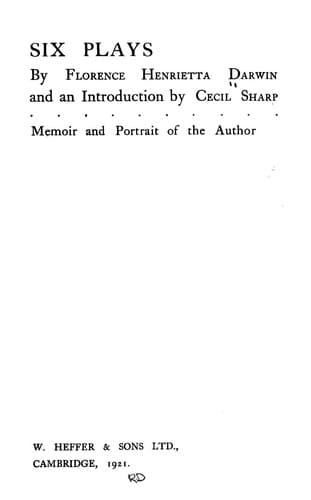
FLORENCE HENRIETTA DARWIN
FLORENCE HENRIETTA FISHER was born at 3, Onslow Square, London, in the
year 1864; but to those of a younger generation it seemed that nearly the
whole of her youth had been spent in the New Forest, so largely did it
figure in her stories of the past. It was at Whitley Ridge,
Brockenhurst, that her earliest plays were written, and many marvellous
characters created; their names still live. It was there that she became
a very good violin player, as well as a musician in a wider sense. It
was in Brockenhurst Church that, in 1886, she married Frederic William
Maitland, later Downing professor of the laws of England.
Mr. and Mrs. Maitland lived in Cambridge; for the first two years at
Brookside, and afterwards in the West Lodge of Downing College.
Public-domain text, read in full here on John Shaqi.
Reviews
Reviews
No reviews yet
Be the first to share your thoughts on this work.
Join the Discussion
Join the discussion
Sign in to leave a comment or review.
Sign InorCreate an account