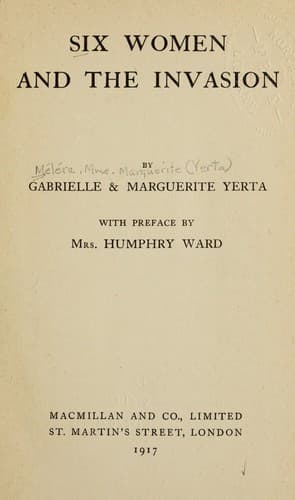
Six Women and the InvasionMéléra, Marguerite-Yerta
History
Six Women and the Invasion
Méléra, Marguerite-Yerta
World War, 1914-1918 -- Personal narratives
By mere chance Morny had as yet paid no more than the contribution of
war which had been levied on the whole country soon after the invasion.
Other villages less fortunate than ours had been overburdened with taxes
upon the most ridiculous pretences. A poor hamlet, Coucy les Eppes, was
fined six times during the space of a few months. First came the general
contribution. Then a fine of half a million francs was imposed upon the
canton of Sissonne, to which Coucy belongs, and every village had to pay
its share. It so happened that in September some soldiers, coming back
from Reims, drove their carts through Sissonne, and as their carts were
loaded with bottles of wine, they drank all the way, and threw empty
bottles behind them. Then came motor-cars, which punctured their tyres
on the broken glass. Great scandal! The civilians were accused of having
put a trap for honest Prussian wheels. Their protestations availed
nothing. The canton was condemned to a fine; the canton must pay; and
Coucy paid like the other communes.
When all houses were searched after the great proclamation of November,
an old flint-lock, kept in memory of an ancestor, was discovered in
Coucy at an old maiden lady's. It never struck the owner that she should
have brought it to the Mayor's house, or hidden it. And suppose the old
maiden lady had shouldered the ancient gun? It is enough to make you
shudder when you think of the danger the German army might have thus
incurred. As quick as could be a few thousand francs were levied on the
village which dared be subversive enough to conceal an old maid and an
old gun. Even then the troubles of the poor village did not come to an
end. A French aviator dropped a bomb on the station, and the bomb
disturbed a few German carriages. The military authority knitted its
brows.
"Why! This Coucy is talked of again! Let it have a good fine, and it
will keep quiet."
For what reasons had this village to bleed itself and borrow from the
town in order to pay the invader twice more, I do not know, but so it
was. Morny's turn was coming. One night a barn of the farm where the
Hussars were quartered took fire, and was soon in a blaze with the straw
it contained. The whole village ran to quench the conflagration. We
stood near-by just long enough to see the peasants put the fire out
with all speed, while the soldiers folded their arms, and were pleased
to be amused. Von Bernhausen and Bubenpech looked on at the spectacle.
Then Von Bernhausen thought proper to rate the Mayor sharply:
"There are not people enough.... Go and fetch civilians.... Be
quick...."
All the able-bodied men of the village were summoned, and they sweated
while the Hussars made sport of them. The _Gazette des Ardennes_, which
took the place of the _Journal de Guerre_ to the very best advantage,
does not relate such accidents in this wise, but I can only narrate what
my eyes have seen.
Public-domain text, read in full here on John Shaqi.
Reviews
Reviews
No reviews yet
Be the first to share your thoughts on this work.
Elsewhere in the archive
Join the Discussion
Join the discussion
Sign in to leave a comment or review.
Sign InorCreate an account