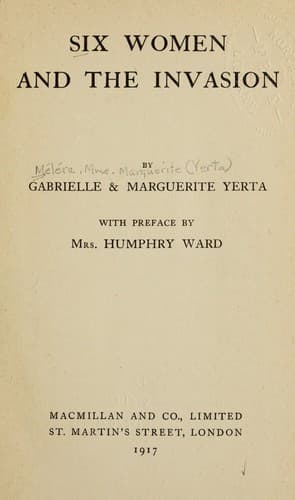
Six Women and the InvasionMéléra, Marguerite-Yerta
History
Six Women and the Invasion
Méléra, Marguerite-Yerta
World War, 1914-1918 -- Personal narratives
Bubenpech rubbed his hands. He had found an opportunity to show his
zeal. With all speed he sent a report to the Staff, upon which he
depended, stating that civilians had set the barn on fire out of spite.
He forgot to add that a few hours before the disaster the Hussars had
burnt their dirty, lousy mattresses in the neighbourhood of the said
barn, where, besides, soldiers had been seen smoking many a time with
perfect serenity.
So stout gentlemen in full uniform came to Morny, and with reproachful
looks stalked majestically through the streets. A chance was given us to
atone for the misdeed. If within twenty-four hours information was
lodged against the civilian who had set fire to the barn, the village
might be forgiven. Should the contrary happen, a severe penalty would be
immediately enforced. No denunciation, and for good reasons. The people
were convinced that the soldiers had kindled the straw on purpose. The
military authorities, grieved to the heart, imprisoned, without further
delay, the Mayor and six notable persons. Then they deliberated upon the
matter, and always regretfully imposed a fine of 16,000 francs on the
village. They ordered the other prisoners to be set at liberty after
three days, but kept the Mayor under lock and key for two weeks, ill fed
and worse lodged. M. Lonet and another municipal councillor went the
round of the village, and did their best to get the sum required. They
managed to collect 12,000 francs, and the Germans had to be content with
that for the present. They knew only too well that they would catch us
again.
Besides other cares worried us. In February 1915 our houses were again
searched from top to bottom. It was proclaimed that the inhabitants
should declare the quantity of corn, flour, and vegetables they had in
store, so that the provisions might be requisitioned according to the
needs of the German army. And mysterious sacks, closed baskets, furtive
barrows were seen in Morny. There was an air of haste; men passed close
to the walls, went along out-of-the-way paths, up to attics, down into
holes. When the day of perquisition came--the Germans believed their own
eyes rather than the declarations of the natives--there were tears and
gnashing of teeth. Treasures were discovered, potatoes and corn dug up.
The Germans laid hold of everything; they even despoiled the very poor
of their slender provisions. For instance, our neighbours, the
Branchiers, a very young couple, whose joint ages were less than forty
years, who had only an empty purse and about thirty kilos of potatoes,
were robbed to the very last shred.
Public-domain text, read in full here on John Shaqi.
Reviews
Reviews
No reviews yet
Be the first to share your thoughts on this work.
Elsewhere in the archive
Join the Discussion
Join the discussion
Sign in to leave a comment or review.
Sign InorCreate an account