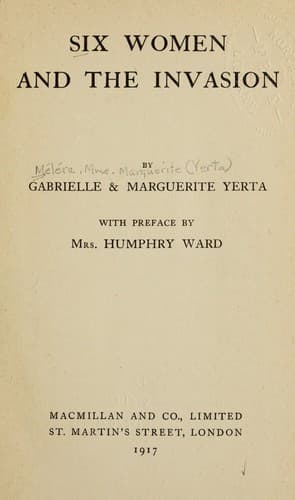
Six Women and the InvasionMéléra, Marguerite-Yerta
History
Six Women and the Invasion
Méléra, Marguerite-Yerta
World War, 1914-1918 -- Personal narratives
That they might not lose a single potato they carefully raked Mme.
Turgau's shed all around, and seized forty, though the poor woman has
four children, who do not live upon nothing. We, in our house, tired of
the war, hid nothing at all. We had possessed for a fortnight four sacks
of wheat, which we had bought from a farmer, who had mysteriously sold
this secret hoard. Where, I beg of you, could you conceal four sacks of
wheat in an honest house? Especially when you know from sad experience
that the perquisitioners perform their office conscientiously. At
Aulnois they had watered a cellar to make sure that the ground had not
been newly dug. At Vaux they had not left twenty centimetres of a
certain garden unexplored. After a long debate we decided to leave
things as they were.
But if peace returns and I am able to build a house, it shall have
hiding-places, wells, tanks, deep dungeons! Hollow walls shall open by
means of secret springs, and two, three, five cellars shall be arrayed
one beneath the other, which, in case of need, shall swallow up whole
herds, to say nothing of a vast reserve of groceries.
Meanwhile, our goods being full in sight, Bubenpech, who, out of
politeness, gave himself the trouble to search our house, visiting every
cupboard and poking his nose everywhere, had been at no pains to
discover them. He declared he was compelled to requisition the corn, but
with a smile he left us our potatoes. Colette was indignant.
"Why! this fellow does not take our potatoes because he wants to be
amiable! And our neighbours have been despoiled of everything! It is a
shame! We must share with the others."
And we did.
A basket to right, a basket to left, a basket over the way, our
provision well-nigh dwindled to nothing. After that we were in the same
state as our neighbours. It is beyond doubt that some people had
managed to save many things, and of course the Germans had surmised as
much. Two or three days after the first perquisitions they dropped in
unawares, and made very profitable visits. Mme. Turgau, for instance,
had succeeded in hiding a sack of wheat, and the soldiers were hardly
out of the way when she baked a loaf to celebrate her good fortune. The
loaf, yellow and round, was displayed on the table, while on the ground
lay the sack, saved from the wreck, and little Lucienne, a slender girl
of twelve, as reasonable as a woman, was grinding corn in a coffee-mill.
Near at hand a dish was already full of flour; after a second operation
of the same kind it would be fit for kneading. The mother was out, the
baby girl, Claire, was busy sucking her thumb, with her admiring gaze on
her sister; the last-born was asleep in its cradle.
Heavy steps broke the silence, big shadows appeared on the door-sill.
"The Prussians!"
The coffee-mill stopped short.
"Ah! ah!" the non-commissioned officer said, "you have corn; you stole
it."
"No, sir, it is just a little bit I have gleaned with mamma."
Public-domain text, read in full here on John Shaqi.
Reviews
Reviews
No reviews yet
Be the first to share your thoughts on this work.
Elsewhere in the archive
Join the Discussion
Join the discussion
Sign in to leave a comment or review.
Sign InorCreate an account