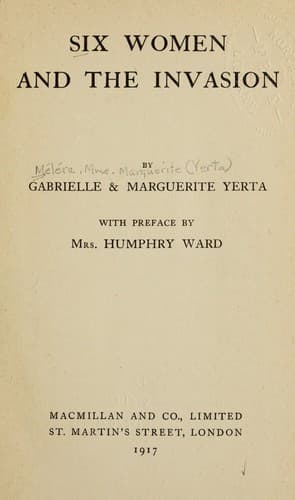
Six Women and the InvasionMéléra, Marguerite-Yerta
History
Six Women and the Invasion
Méléra, Marguerite-Yerta
World War, 1914-1918 -- Personal narratives
I will seize upon the occasion to give a short description of our dear
old house. Notched like a saw, the gabled front presents a row of
shutters, which, like grey eyelids, secure us from indiscreet looks. To
the right and the left two large iron gates, always carefully closed,
lead one into a paved yard, the other into a narrow road, planted with
trees. The side of the house, looking out on the high-walled garden,
throws off the reserve in which the front is shrouded; windows and doors
are always wide open to the air, the sun, and the creepers, whose
branches penetrate even the rooms themselves. Inside, a passage
separates the house into two parts, the dining- and the drawing-rooms on
one side, and on the other the bedrooms and the kitchen. Geneviève,
Colette, and Mme. Valaine have their rooms downstairs. Upstairs the
attic has been cut up pleasantly into three. Outside, parallel with the
house, a small building opens into the yard, containing a wash-house, a
room--the small room--a coach-house, a stable, and the whole is topped
by an attic.
The house--this does not allow of discussion--is too small, or the
family is too large, and Antoinette, who wanted a room to herself,
declared: "I will settle in 'the small room,'" and we could not get it
out of her head, although we enlarged,--with some complacency--upon the
dangers she might run alone by night.
"The walls are high, the doors strong. I am not afraid, and then there
are the dogs."
Indeed, Gracieuse and Percinet, the collies we dote on, live next door,
and have sharp sets of teeth which they show to all intruders.
"Grandmamma," said Antoinette the next morning, "last night, about
twelve...."
"The proper time for crimes."
"I was startled out of my sleep."
"You were dreaming of the Germans."
"No, no. Some one was in the attic above my room."
"There you are! A spy! Have you run him in?"
"Without joking, Grandmamma. I heard steps quite clearly."
"Do you know that deserters are said to have escaped near Morny?"
In process of time the deserters were proved to be dormice, but we
thought the mistake amusing, and ever after called the attic "the
deserter's attic." Life went on. Dull, spiritless, insignificant in
Morny; immense, tremendous, and tragical beyond there in the North and
the East. We longed for the postman the whole day long. He had few
letters for us, but he still brought papers. We read them carefully, and
we were none the wiser. We ought to have read between the lines, but we
could not. I assure you that, during the end of August, we were deaf and
blind. Our reason refused to believe the testimony of our senses. We saw
thousands and thousands of people whom Belgium and the North had cast
away, the Belgian army driven back from Flanders, the staff officers
settle in Laon, and we never came to the right conclusion.
Public-domain text, read in full here on John Shaqi.
Reviews
Reviews
No reviews yet
Be the first to share your thoughts on this work.
Join the Discussion
Join the discussion
Sign in to leave a comment or review.
Sign InorCreate an account