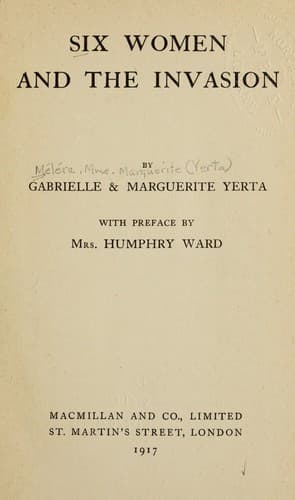
Six Women and the InvasionMéléra, Marguerite-Yerta
History
Six Women and the Invasion
Méléra, Marguerite-Yerta
World War, 1914-1918 -- Personal narratives
In other villages it was still worse. A man of Barenton set his house on
fire and hanged himself rather than leave. Some persons were sent away
because the Germans coveted their houses for one purpose or another. At
Vivaise the wife of an adjutant was compelled to leave her
well-furnished house for the reason that it pleased those gentlemen. So
a blind woman and her invalid husband, both aged seventy-five, were
banished from Verneuil. In tears they left their small house where they
had lived happily for many a year, their garden, whose fruits were
sufficient for their scanty needs. Besides, they had a few fowls and a
little money, and so they were not in the least a charge upon the
Germans. Of course they expected everything to be plundered and
destroyed, and, weak and old as they were, they saw no hope that they
would ever come back.
We were volunteers, at one moment distressed at the thought that we left
three of our own people in the lurch, at another mad with joy that we
should soon be at liberty, or trembling with fear lest we should hear
bad news of those whose fate was hidden from us.
About the end of March, after many tears had been shed, embraces and
kisses exchanged, after the very dogs had been hugged, we found
ourselves in front of the "bureau" with the other departing travellers.
We all got into two big carts, and sat down on our luggage. The
departures were somewhat delayed. We had to wait for the woman who did
not want to go away.
At ten the carts set out.
"Good-bye, we shall see you later in Paris," Bubenpech cried.
It was the parting kick of the ass.
Public-domain text, read in full here on John Shaqi.
Reviews
Reviews
No reviews yet
Be the first to share your thoughts on this work.
Elsewhere in the archive
Join the Discussion
Join the discussion
Sign in to leave a comment or review.
Sign InorCreate an account