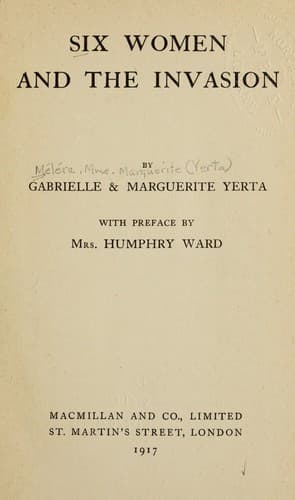
Six Women and the InvasionMéléra, Marguerite-Yerta
History
Six Women and the Invasion
Méléra, Marguerite-Yerta
World War, 1914-1918 -- Personal narratives
"Then you will come as a prisoner," replied Antoinette, laying aside all
prudence. The officer broke out laughing and turned a deaf ear. With a
great deal of jolting, the carts took us away, and we soon lost sight of
the pale faces of Mme. Valaine and her daughters. Two gendarmes on
horseback accompanied us. Thus we were enrolled among the emigrants. We
alighted in Laon, and were shown into a huge hall adjoining the station.
The little emigrants of Cerny were still screaming, the refractory woman
had not left off crying. Pierrot felt uneasy, and hung on my arm; we
dragged our luggage along with a great deal of trouble. The hall we were
taken to was already crowded with hundreds of persons. From early
morning the refugees had been arriving in great numbers. Long rough
boards nailed upon four upright pieces of wood served as tables and
benches. Besides the picture of the emperor the walls were chiefly
decorated with vast inscriptions. "God with us" was not absent; nor was
"God punish England," in letters three feet high. The shrieking of the
urchins, their mothers' scolding overtopped the general noise. The old
people looked scared, and did not know what to do. On the rough tables
soldiers put platters of a sticky, greyish soup; a smell of burnt grease
floated in the air. We were waiting for our turn to go to a small room
where three nurses of the Red Cross were busy feeling, searching,
undressing the emigrants as they pleased.
"No papers, no letters?"
At two every one had filed off before these searchers, and we were
ordered to start again. So through the streets of Vaux the pitiful crowd
wended its way to the station, about twelve hundred emigrants surrounded
by soldiers. From their thresholds the inhabitants stared at us. Truly a
more miserable herd never was seen. The Germans had chosen to send away
the poorest among the poor of our villages--bareheaded women, ragged
children, beggarly men, sick people, cripples, idiots. All were laden
and overladen with parcels, baskets, and bundles. There were two or
three carts to convey the heaviest luggage, but every one preferred
keeping what was dearest to him.
We, too, were overladen. We made what haste we could among the grey
crowd. We had walked a mile, I could hardly carry my bag any longer. At
one moment it even dropped from my hands. I approached an officer, stiff
and stout, who seemed to be the manager of the caravan.
"Sir," I besought, "please order a moment's rest.... I can't go any
farther."
"No, no, no halt. If you can't carry your things, ask some one else."
Some one else! That was easy to say. I looked around me despairingly;
the people were all as weary as I.
Pierrot stuck to my arm, Antoinette was somewhere in front, Geneviève
was spent with fatigue. Near us a soldier seemed touched with pity.
"I am sorry I can't help you, but it is forbidden."
Public-domain text, read in full here on John Shaqi.
Reviews
Reviews
No reviews yet
Be the first to share your thoughts on this work.
Elsewhere in the archive
Join the Discussion
Join the discussion
Sign in to leave a comment or review.
Sign InorCreate an account