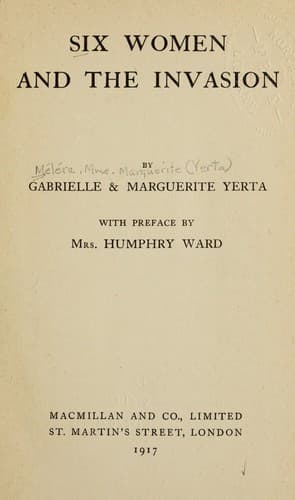
Six Women and the InvasionMéléra, Marguerite-Yerta
History
Six Women and the Invasion
Méléra, Marguerite-Yerta
World War, 1914-1918 -- Personal narratives
our limbs gathered up together, our chins on our knees, our feet stuck
in our muffs, with a sore throat and a giddy head we made up our minds
to wait for the morning, to take stock of our situation, and to find out
in what place fate and the Germans had deposited us.
In the whole Thiérache, teeming with lovely hamlets, I warrant that
there is no other so pretty as Jouville. It is perched half-way up the
hill on the high-road to Guise, and its houses, first set in a straight
row along the road, soon take a short-cut, and then descend the vale,
where they meet with the purling Serre. They dawdle there in small
knots, and storm a second hill, topped by a white steeple-crowned
church. This building is not in the least handsome, yet it sowed
dissension among the inhabitants. Jouville-East-Hill laid claim to the
pious edifice; Jouville-West-Hill got it. Jouville-East-Hill forthwith
took to free-thinking, flung itself into the socialist party, and swore
it would never cross the Serre to gratify the spiritual needs of its
souls. On the other hand, Jouville-West-Hill took a most serious turn,
swore only by holy-water sprinklers and stoles, and sang nothing but
vespers and matins. Jouville, in ordinary times, gives itself wholly up
to cultivation of apples, to cattle-breeding, and to wicker-weaving.
Each occupation adds a feature to the village. The apple trees fill the
well-kept orchards that hem it all around; those meadows that stretch
afar off feed the cows, and the willows, which will presently be
converted into baskets, form thick hedges and make a draught-board
pattern in the fields. The village, indeed, is packed with osiers, cut,
tied in bundles, placed upright along the streets, and watered by the
brook. So they grow green, and are covered with catkins, just like their
brothers that have not been cut. The houses of Jouville are small, red
and white, beneath a slate hood; their windows laugh a roguish laugh. On
their roofs are fantastic weathercocks, and in front of them small
gardens, in which box-trees flourish, cut into shapes. In short,
Jouville looks at once simple and smart, modest and satisfied, and its
mere aspect should cheer up the way-worn wanderer. Though this rustic
Eden pleased us, we had no mind to take up our abode in it. The day
after our arrival, we managed to ask an officer:
"What is the matter? What are we doing here?"
"Oh, the departure has been postponed, the organisers of the convoy are
not in agreement."
"But how long are we going to stay here?"
"Not longer than a few days; you need not be afraid."
Public-domain text, read in full here on John Shaqi.
Reviews
Reviews
No reviews yet
Be the first to share your thoughts on this work.
Elsewhere in the archive
Join the Discussion
Join the discussion
Sign in to leave a comment or review.
Sign InorCreate an account