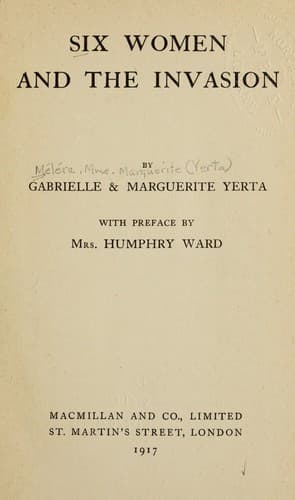
Six Women and the InvasionMéléra, Marguerite-Yerta
History
Six Women and the Invasion
Méléra, Marguerite-Yerta
World War, 1914-1918 -- Personal narratives
Although we were forewarned, our simple minds would not believe in
duplicity. We were reassured.... A few days would soon glide by. When a
soldier talked of a whole week, he astonished us. The chief cook in the
kitchen, where he was superintending a swarm of busy scullions, dared to
murmur three weeks, and he was hooted at by everybody. In the farm and
in the sugar-mill the emigrants settled themselves as well as they
could. A pitiful place, in which straw was expected to do everything!
The straw served as seats and mattresses, it served as blankets, it
served as shutters and padding. Nothing but straw to preserve oneself
from the cold. And the cold was terrible. I think that we shall never
suffer from anything as we suffered from the cold in Jouville. It was
the icy chill of the seventh cycle of Hell, the chill that pierces you
to the very marrow of the bones; it was the chill of death.... For a
whole week we tried vainly to warm ourselves. The weather was clear; the
wind blew with fury; the frozen ground was as hard as stone; icicles
were dangling from the gutters; and the emigrants' teeth were
chattering. They bent their shoulders, thrust their hands in their
arm-pits, and wandered up and down. Some had on only rough linen
clothes. From the yard they went up to the attic, from the barns to the
kitchen, in quest of a bit of warmth, and they looked so cold that the
mere sight of them heightened your misery.
In the sugar-mill some people had the luck to lodge in rooms that could
be heated. But what of those who dwelt in attics through which the wind
was blowing just as it did outside, or in cellars where they sat in a
perpetual draught? The manifold misery we were the witnesses of was
beyond description. I remember a room in the sugar-mill where about
fifty emigrants had been huddled together--men and women, old people and
children, in ill health or in good. It was a long, icy-cold room, with a
low ceiling, feebly lighted by two deep windows in the shape of
loopholes. At the threshold the odour of sick and dirty humanity
suffocated you; the children's squalling, the mothers' scolding, the
men's rough voices stunned you. In the dimly lighted room you perceived
a path opened through the straw, spread out on both sides, on which you
saw creatures crouched or lying. You stumbled on baskets, kitchen
utensils, and bundles, had to shun wet linen and children's clothes,
which the women had stretched out in the fallacious hope of drying them.
When your eyes got somewhat used to the sober light of the place, you
were able to single out the sick or the old people lying about the
straw, the mothers suckling their babies, the men leaning against the
wall. You saw their pale worn faces, their hands benumbed with cold,
their thin clothes. And if you stopped to talk to them they told you
many bitter, heart-rending stories. In a corner a girl of twenty was at
the last gasp. She had but one lung left, and spat blood, while small
Public-domain text, read in full here on John Shaqi.
Reviews
Reviews
No reviews yet
Be the first to share your thoughts on this work.
Elsewhere in the archive
Join the Discussion
Join the discussion
Sign in to leave a comment or review.
Sign InorCreate an account