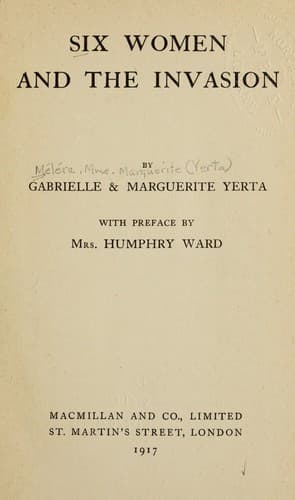
Six Women and the InvasionMéléra, Marguerite-Yerta
History
Six Women and the Invasion
Méléra, Marguerite-Yerta
World War, 1914-1918 -- Personal narratives
children were playing about her. It was the hopeless horror of a
concentration camp. Yet the commandant of the convoy, a lieutenant of
the reserve, a good man after all, and the father of a family, did his
best with the poor means at his disposal. Once even we saw a tear roll
down his cheek at a distressing sight. The weather being inclement, he
gave orders to have the greater part of the emigrants lodged in the
village. The sick first, then the women and the children would be
provided for. There was great excitement. A choice was made, and after
three days and a good deal of writing, the farm and the sugar-mill had
but a hundred occupants left, all huddled together in the few habitable
rooms. The rest encamped in empty houses, slept on straw, a dozen in a
room. At any rate they were under cover, and could warm themselves or
accept the hospitality of the inhabitants of the village. Such was our
case. Charming people gave us shelter, and placed two rooms at our
disposal. We had beds. After we had spent three nights on a spring
mattress and had shivered all the while, how pleasant it was to go to
bed! But our apartment was not heated, had not been lived in for a long
time, was impregnated with damp, and, chilled as we were, we recovered
warmth only a few days after.
The life of the camp was organised after the military fashion. We were
expected to obey at a glance.
In the morning, as early as half-past seven, the emigrants hastened to
the sugar-mill or the farm, where each was inscribed in the place where
he slept the night before. A grown-up member of each family presented
the cards of those with him. In the two courtyards the emigrants filed
past from right to left, and answered to their names mangled by the
_Feldwebel_. Then came the daily allowance of coffee. Armed with
saucepans, jugs, pots, and cups, women and urchins went to the kitchen
to have them filled. They returned home, and at eleven o'clock, with
porringers, pails, and coppers, they made again for the farm or the
sugar-mill, to bring them back full of soup. Towards evening they wended
their way a third time to fetch coffee for their supper.
Public-domain text, read in full here on John Shaqi.
Reviews
Reviews
No reviews yet
Be the first to share your thoughts on this work.
Elsewhere in the archive
Join the Discussion
Join the discussion
Sign in to leave a comment or review.
Sign InorCreate an account