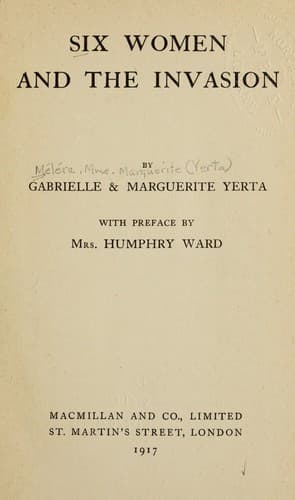
Six Women and the InvasionMéléra, Marguerite-Yerta
History
Six Women and the Invasion
Méléra, Marguerite-Yerta
World War, 1914-1918 -- Personal narratives
"They will take us to Germany. And we can't go on living here! Our brats
have no more shoes; their clothes are in rags; it is no use to darn
them, they fall in pieces."
"But the worst is that we are hungry. We could stand it, but our
children, our little ones, are hungry."
And it was only too true, we were hungry, every one was hungry. What!
Did the Germans not feed us? Of course they did! And on what! Twice a
day each emigrant got a bowl of coffee. A bowlful or a dishful as you
liked, this lukewarm beverage was not given out with a niggard hand.
Lukewarm it always was, and thin too--stimulants ought not to be
misused,--and blackish with a smell of mud. It was without sugar or
milk, and there was no danger of feeling heavy after you had swallowed
it. If the children fell a-weeping in the night, after having swallowed
one cup of this coffee for their dinner, their mothers knew they were
not going to have an attack of indigestion. We got bread. It was real,
authentic German bread, kneaded and baked by Germans. Coloured outside
like gingerbread, it was turtledove grey inside, and would have looked
rather tempting but for the unbaked or mouldy parts. We supposed that
rye-flour, pea-flour, and potato fecula were largely used in the making
of it. Some pretended that they found sawdust in it too. I could not
affirm this. I was rather inclined to think that chemicals had induced
the heavy dough to rise. When new, this somewhat sour-tasted bread was
nice enough, and we ate it without distrust the first days we spent in
Jouville, as the bracing air gave us an appetite. Alas! it soon caused
us pains in the stomach, sickness, inflammation of the bowels, in short
put our digestive organs out of order. The emigrants ate it all the
same; indeed they could not get enough of it. The first three weeks the
Germans made a show of generosity: every person received a loaf every
third day. The weight of one loaf was supposed to be three pounds, in
reality it never exceeded thirteen hundred grammes. But the daily ration
was sufficient, and nobody complained. Unfortunately the allowance
became more and more stingy; during the last month every one received
one pound every third or even fourth day. One hundred and twenty-five
grammes--our daily pittance--do not represent a large slice, and the
people began to clamour for food. We got soup. We were entitled to a
ladle of soup by way of lunch. Shall I describe this mixture? Is it not
already famous in both continents? Do our prisoners not feast upon it in
Germany? It is a grey, thick substance which curdles like flour paste,
whose chief ingredient is fecula. Each portion contained five or six
tiny bits of meat, coming undoubtedly from over-fat animals, for we
never saw a scrap of lean. A few horse- or kidney-beans, a little rice
or barley, mixed with bits of straw, bits of wood, and other scraps of
vague origin. Antoinette had once a real godsend. She discovered in her
soup-plate ... she discovered ...
Public-domain text, read in full here on John Shaqi.
Reviews
Reviews
No reviews yet
Be the first to share your thoughts on this work.
Elsewhere in the archive
Join the Discussion
Join the discussion
Sign in to leave a comment or review.
Sign InorCreate an account