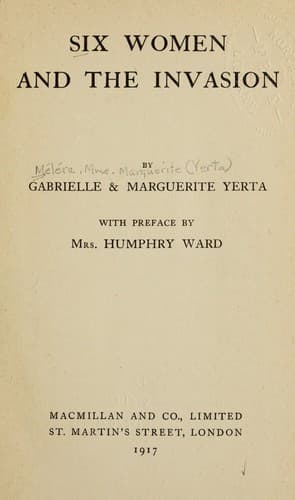
Six Women and the InvasionMéléra, Marguerite-Yerta
History
Six Women and the Invasion
Méléra, Marguerite-Yerta
World War, 1914-1918 -- Personal narratives
how can I tell? Oh, shade of Abbé
Delille, inspire me to paraphrases! She discovered one of those
animalcules which ... plague take oratorical precautions! She found a
louse on a hair, the whole boiled. This took away what was left of our
strength, and we swore we would rather waste away, and slowly dry up,
than eat such stew in the future.
"Look at this, madam, look at this hodgepodge," moaned the women. "At
home we would not have given this rotten stuff to our pigs, and now we
must feed upon it, and give it to our children."
M. Charvet, our host, cast a look of dismay at our porringers.
"As to myself, I should die beside this, but I would never taste it."
And yet the emigrants were obliged to eat it. From the first days of our
arrival we set our house in order. Our bedrooms were at Mme. Charvet's,
but we spent the whole day long at the rural constable's. The
constable--a brave old man, wounded in 1870--gave up his large kitchen
to us, and supplied us with wood at very little cost. In a corner of the
kitchen stood a large four-post bed which received at night three of our
protegées: a lady eighty-five years old, and her two grand-daughters
aged seven and twelve years. Mme. Noreau, Mimi, and Miquette were
respectively mother and daughters of a retired officer who lives at
Coucy. Of course the officer and his two sons had not been allowed to
go, and his wife had refused to leave them. But they took the chance of
sending into France the grandmother and the little girls, who had
greatly suffered from their life of privation. From the first evening,
the sight of these helpless figures upholding one another had moved our
pity. They gratefully accepted our proffered friendship and assistance.
This is then the way we came to rule such a large household at the old
constable's. A good oven served at once to heat the room and cook the
food. For excellent reasons our stew was of the simplest. A few eggs,
milk, sugar, and butter were to be had in the village, but as we had
absolutely no other article of food--no meal whatever, no vegetables, no
meat,--we were hungry despite custards and omelettes. I said we had
tried to swallow the soup. We gave it up on account of the adventure
afore mentioned after a fortnight of earnest endeavours. So much the
worse, we said; we will live with empty stomachs. Many others were in
the same plight. We were privileged beings, for only a few among the
emigrants had a little money, enough to get something besides the usual
fare supplied us by our jailers. I leave you to imagine the appetite of
those who were reduced to bread, coffee, and soup in all. And remember
that among them there were two hundred and eighty children under ten
years who were not merely starved, but half-naked as well. The charity
children were more miserable than the others. In the bitter cold weather
they wound rags round their legs by way of stockings; their shoes were
shapeless things, held together by string, their trousers were torn,
Public-domain text, read in full here on John Shaqi.
Reviews
Reviews
No reviews yet
Be the first to share your thoughts on this work.
Elsewhere in the archive
Join the Discussion
Join the discussion
Sign in to leave a comment or review.
Sign InorCreate an account