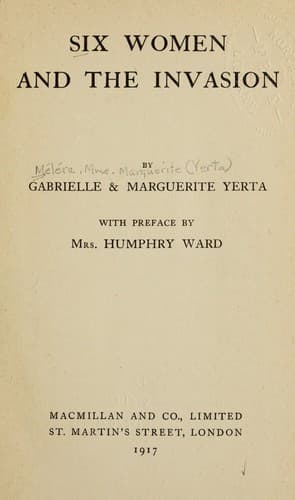
Six Women and the InvasionMéléra, Marguerite-Yerta
History
Six Women and the Invasion
Méléra, Marguerite-Yerta
World War, 1914-1918 -- Personal narratives
Our medical attendant was a young coxcomb, fair-haired,
regular-featured, and harsh-looking. A glass was fixed in his eye. About
half-past nine his carriage, drawn by a pretty horse, pulled up;
carelessly he threw the reins to his groom; he alighted and penetrated
his domain. His Lordship sat down in an easy-chair, crossed his legs,
took a haughty survey of the patients who called upon him, and spoke in
a curt and supercilious tone. He was soon held to be a villainous
fellow.
"He is as wicked as the devil," a woman said, with a look of dismay.
A great many of them wanted their children to be examined by the doctor.
"I would rather die on straw than go to him for myself," a mother
said ... "but, my poor little girl!"
But what was worse, the Prussian doctor did not care a fig for sick
children! We had been told that every baby was entitled to a litre of
milk, which one of the farmers of the village would deliver to the
mother on presentation of a note of hand. But a child above two years
was allowed to drink milk only if the doctor deemed it expedient for its
health. A woman we knew had a little girl not yet three. Six months
before the whole family had fled in a shower of bullets and grape-shot,
and for nearly a month had lived in the depths of a dark stone quarry
with hardly anything to eat. Since then the child had been as white as
wax; she had no strength at all, and she was always staring straight
before her as if she had beheld horrible things.
As she was penniless, the woman was forced to bring her child to this
medicaster.
"Sir, you see my little girl ... I think milk would do her good...."
He had but to write a note, and she would have had it.
"Milk! I haven't any! I keep no cows in my house!" and the doctor burst
out laughing, thinking himself very witty.
"Anyhow," the mother said with her teeth ground, "when he stays at home
there is a brute beast in his house worse than a cow."
Another beggar woman had twins about two years old. One of them ate soup
and bread, and throve like couch-grass. The other, who ever since the
family had left their native hamlet had fed on indigestible things, and
had nowhere to lay her head, had grown pale and sickly. She had ceased
to run alone, took no food, and pined away visibly. Her mother brought
her to the doctor.
"That child! What should I prescribe her? She is ailing on account of
her being French. French children are all rickety and weakly. How am I
to help it? Lay the blame on your race."
Before leaving, the little doctor sometimes gave a glance--a single
one--at the rooms of the hospital, then stepped into his carriage, took
up the reins, cracked his whip, and as harsh-featured as ever put his
horse to a gallop.
Public-domain text, read in full here on John Shaqi.
Reviews
Reviews
No reviews yet
Be the first to share your thoughts on this work.
Elsewhere in the archive
Join the Discussion
Join the discussion
Sign in to leave a comment or review.
Sign InorCreate an account