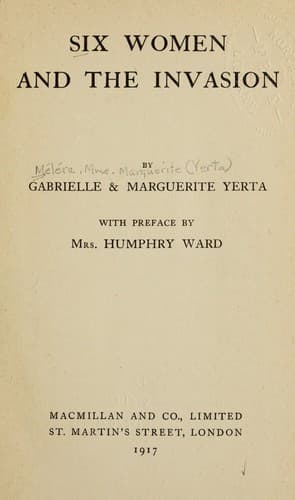
Six Women and the InvasionMéléra, Marguerite-Yerta
History
Six Women and the Invasion
Méléra, Marguerite-Yerta
World War, 1914-1918 -- Personal narratives
I suppose she noticed our admiring gaze, for she said all of a sudden:
"Would you like to have some?"
She tripped along quickly, and, with short steps, went to her kitchen,
came back with a knife, and cut off two large slices, which she held out
to us. We seized the bread with an avidity hardly tempered with shame,
and stammered out joyful thanks. This moved the compassion of the good
woman:
"Fancy, they are hungry! What a pity! Such lovely girls!"
And so, jumping from one stone to another in the muddy path down the
river, we burst into unrestrained laughter, and we devoured our bread
which was the real bread, the white bread of France. We had, indeed, not
a few windfalls. M. Charvet more than once presented us with one of
those pretty round loaves, which he kneaded and baked himself.
We also were hand in glove with a farmer, who sometimes in secrecy let
us have a few potatoes or a pound or two of flour, and thus gave us the
means of adding something to our meagre fare. A few treats of that kind
helped us to hold out! We looked like corpses, and we were, one after
another, the victims of strange pains caused by the cold, the bread, and
the continual excitement.
Most of the emigrants were ill. Eight of them died. We then had occasion
to see and admire the way in which the Germans organise the sanitary
service for the use of civilians. From the very first day an empty house
had been bedecked with the title of hospital, and adorned with the
scutcheon of the Red Cross. A large room directly opening into the
street was chosen for consultations; two smaller rooms containing
symmetrical heaps of straw served to receive the patients. There was a
permanent orderly in the camp, and a doctor came daily from Marle.
Emigrants, choose what sickness you like! You will be cared for!
And quickly influenza, diphtheria, bronchitis, inflammation of the lungs
burst upon the emigrants. But we soon discovered that it was not easy
to be admitted to the sick ward. I had to call four times on the officer
before they vouchsafed to take away an old couple who, despite the
Siberian cold, lived alone in a barn with big holes in its roof. The
poor woman coughed pitifully, and her old companion could only bring her
lukewarm coffee and heap upon her mountains of straw. She died two days
after she had been transferred to the hospital. An old woman died, her
body was carried away, and quickly another old woman took her place on
the very same couch of straw. A dying woman, utterly unconscious, was
left a week unattended to.
"I assure you the corner she was in was a very sink," said the man who
took upon himself to clean it when the corpse had been taken away. "And
my wife and children had to live in this infected spot!"
Public-domain text, read in full here on John Shaqi.
Reviews
Reviews
No reviews yet
Be the first to share your thoughts on this work.
Elsewhere in the archive
Join the Discussion
Join the discussion
Sign in to leave a comment or review.
Sign InorCreate an account