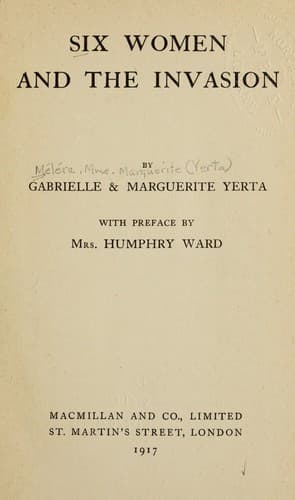
Six Women and the InvasionMéléra, Marguerite-Yerta
History
Six Women and the Invasion
Méléra, Marguerite-Yerta
World War, 1914-1918 -- Personal narratives
Our leisure was propitious to gossip, and we spent many an hour
listening to those who had seen the first tragical events of the
invasion. Their simple, unvarnished tales were like so many nightmares.
For instance, there were bargemen of Braye whose boat had been split in
two by a cannon ball, and who had escaped death only by swimming and
clinging to floating planks. There was the woman of Corbeny, driven by
the Prussians from a village near Soissons. With several others she
walked to Cerny at a stretch, with the Germans ever at her heels. The
unhappy wretches had covered forty kilometres in the midst of a battle,
spent with weariness, breathless, tumbling down, and trudging off again.
Three of them were killed on the way. The woman who gave us an account
of this carried her baby, aged eighteen months, throughout this wild
race, and on the way the poor little thing was wounded twice in her
mother's arms. Of Cerny were the poor creatures who were shut up in a
deep stone quarry, and stayed there with scarcely any food for
twenty-seven days. When they were taken out and brought to Laon they
were pale, hollow-cheeked, and covered with vermin; they could hardly
walk by themselves, and their eyes could not look upon the daylight.
"The people wept as they saw us go by," the women said. During the first
hours of their sojourn in the stone quarry, there had been a tragical
incident. The fugitives were crouching in the dark when an officer broke
in, accompanied with soldiers:
"Some of you," he said, "have harboured Englishmen. We discovered an
English officer lying in such and such barn, in such a place. We have
set the building on fire."
"Ho," said a man, "my barn!"
"Ah, it was yours! You knew an Englishman was hidden in it? Come on."
The poor man vainly protested against the accusation; he was taken away.
The following day he had not yet returned. His wife was greatly
disturbed, and despite the danger made up her mind to go and try to see
him. She took some chocolate out of the slender store of the refugees.
"They have thrown him into prison," she said, "and I am sure they will
starve him to death."
The woman went. The village was half in ruins, and the ruins smoked. All
was deserted. She summoned up her courage, went straight to her house,
walked into the yard, and, close to the dunghill, his face fallen in the
filth, his hands tied behind his back, saw the corpse of her husband. He
had been shot twice in the head, and his side was pierced with a large
wound.
The victim's brother and the niece from whom we heard this story, were
not allowed to attend his burial.
From the same part were two ladies, a mother and her daughter, with a
new-born baby, who were flung out of their house with only a
dressing-gown and slippers on, and driven on without stopping at the
bayonet's point, until they reached Laon, half distracted.
Public-domain text, read in full here on John Shaqi.
Reviews
Reviews
No reviews yet
Be the first to share your thoughts on this work.
Elsewhere in the archive
Join the Discussion
Join the discussion
Sign in to leave a comment or review.
Sign InorCreate an account